Brush Strokes on Trim and Doors — Why They Show and How to Lay Paint Flat
Brush strokes on a finished door or trim mean the paint film froze before it self-leveled. Pick leveling-engineered paint, swing a real brush, condition the can with Floetrol, and the stroke lines disappear.

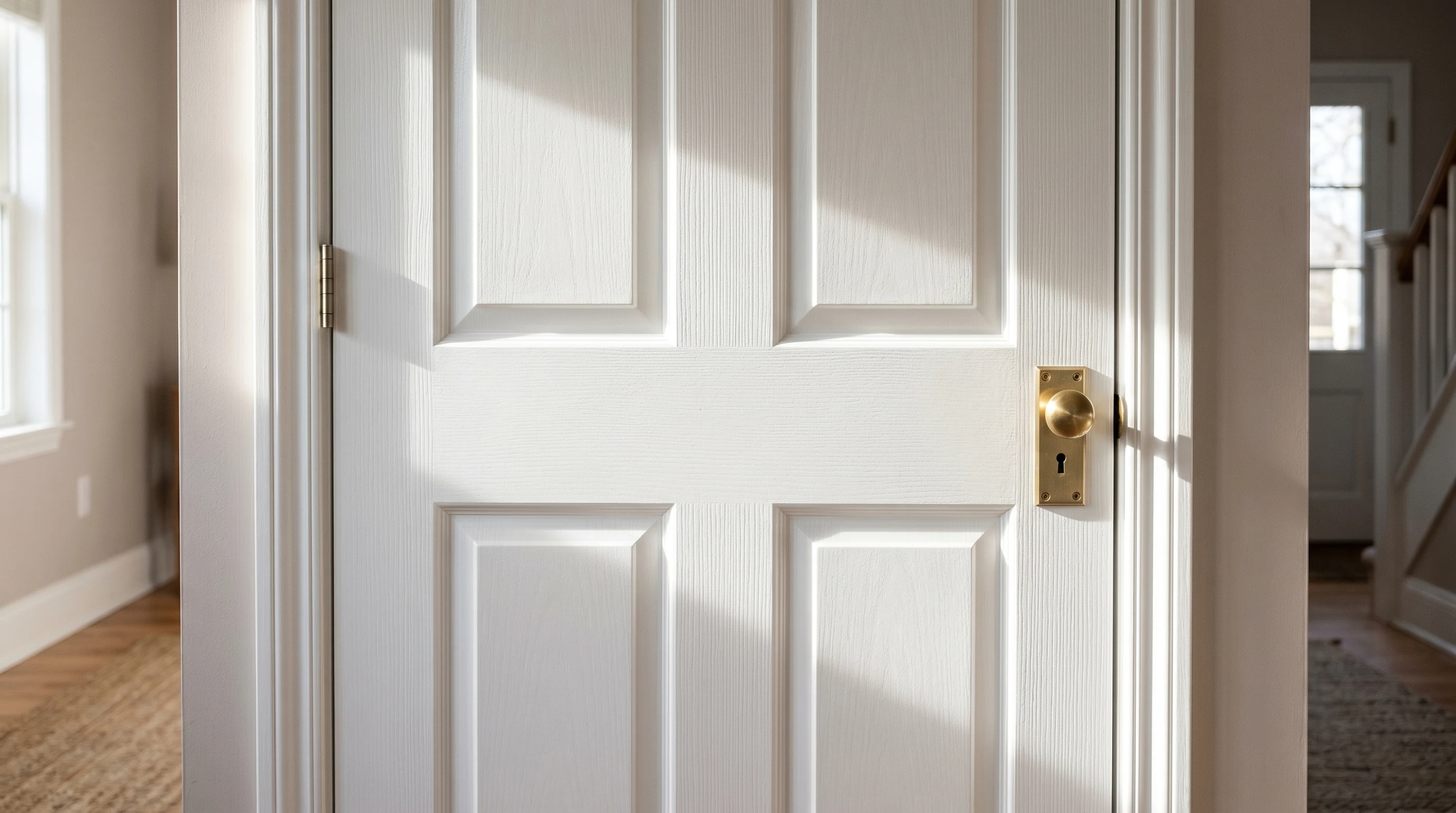
Brush strokes on a door tell me three things about the painter, and none of them are nice. Wrong paint in the can, wrong brush in the hand, wrong technique on the surface. Diagnose which one (probably all three), and the next door reads flat.
Does this match what you’re seeing?
Look at the door under raking light from a side window. You’ll see one of these.
- Fine parallel ridges running with the brush direction. Classic bristle tracks. The paint set before it could level out.
- Tracks that change direction at panel joints. You over-brushed where the rails meet the stiles. Every shift in stroke direction got frozen in the film.
- One section reads flat, another reads streaky. Hot spot. The streaky panel got hit by sun or a heating vent and the film flashed before it could flow.
- Stroke lines plus a faint roughness you can feel. You used wall paint on the door. The film never had the chemistry to level in the first place.
- Brush lines on flat areas but smooth in the panel insets. You kept going back over the flats after the paint started to set. Tip-off in one direction and walk away.
If the door feels gritty when you run a fingertip across it, dust landed in wet paint. Different problem, same fix path: sand and recoat.
How serious is this
Cosmetic. The door functions, the film is sealed, hinges still swing. What it isn’t is invisible. Brush strokes on a six-panel door catch raking light from any window in the room and the eye lands on them every time you walk past.
A second coat with the right paint, the right brush, and Floetrol in the can fixes 95 percent of brushed doors. The other 5 percent are wall paint on cabinets, where the only honest answer is sand to bare and start over.
Why brush strokes show (root cause)
Three causes, ranked by how often I see them on a finished door.
1. Wrong paint for the job. This is 60 percent of every stroked door I’ve looked at. Latex flat or eggshell wall paint is engineered to dry FAST and STAY where you put it. That’s exactly what you want on a wall and exactly the opposite of what you want on a door. Trim paint — Benjamin Moore Advance, Sherwin-Williams Emerald Urethane Trim Enamel, INSL-X Cabinet Coat — is engineered around a slower open time and a self-leveling resin system. The brush stroke flows out before the surface sets. Wall paint can’t do that. The chemistry isn’t there.
2. Wrong brush. A $4 china-bristle brush leaves visible track lines because the bristles are uneven, blunt, and release paint at random thicknesses across the face. A Wooster Silver Tip, a Purdy XL Glide, or a Wooster Pro Nylox lays a uniform film because the bristles are tipped, blended, and tapered to release paint evenly across the stroke. The brush is doing half the leveling work. Cheap out and the paint has to do it alone, which it can’t on a stroke that wide.
3. Wrong technique. Brushing in too many directions, going back over leveled paint as it sets, working in a 80°F room with a ceiling fan running. Each one of those locks bristle tracks in the film. The right move is load, lay on, tip-off in one direction, leave it alone.
A fourth one shows up. Painting a door horizontally on sawhorses in direct sun. The film flashes off in two minutes. Doesn’t matter what’s in the can. Move the door indoors or wait for shade.
The right technique on trim and doors
Numbered because the order matters more than the steps.
- Load the brush a third of the bristle deep. Not half, not the ferrule. Load light, lay on a wide section, reload.
- Lay paint on with the grain. First strokes go on heavy and uneven. That’s fine. You’re depositing material, not finishing yet.
- Smooth with light tip-strokes in one direction. Long, single-direction passes from one end to the other with just the bristle tips touching the wet film. With the grain, every time, no matter what.
- Don’t go back over leveled paint. Once the film starts to flow out, every brush stroke you add creates a new track that won’t level out behind it. Walk away.
- Cut panel insets first, flats second. Otherwise you brush wet flat-paint into a still-wet inset and pull a track straight across the door.
- Two thin coats, four hours apart. One heavy coat sags and cures soft. Two thin coats level individually, build film thickness honestly, and cure hard.
- Room at 70°F, no fans, no direct sun. The label specs assume those conditions. Hotter or windier than that and the open time collapses.
Floetrol and Penetrol — the leveling fix in a bottle
When the room is fighting you and you can’t get conditions perfect, condition the paint instead.
Floetrol is a latex paint conditioner from Flood (a PPG brand). Half a cup per gallon, stirred in. Adds 30 to 50 percent to open time without thinning the film, without changing color, without softening the cured hardness. Used on waterborne trim paint, it widens the leveling window enough that decent technique reads as great technique. Around $15 a quart, treats six to eight gallons.
Penetrol is the same brand’s product for oil-based paint. Same shelf, same dose, different chemistry. Don’t substitute one for the other — Floetrol in oil paint or Penetrol in latex thins the film without leveling it.
Neither one fixes bad technique. Half a cup of Floetrol won’t save a door brushed in three directions with a $4 brush. What it does is widen the window where good technique works.
Spray-and-tip-off, the cabinet-quality move
Past a certain quality bar, no amount of brush technique catches up to spray. Cabinet doors, front entry doors, anything where the surface is the focal point of the room.
The pro move is HVLP-and-tip-off. Spray a uniform coat with an HVLP gun, then immediately tip-off with a barely-loaded Wooster Silver Tip in one direction with the grain before the film starts to set. The sprayer lays a flat film in seconds. The tip-off catches any orange peel and pulls the surface dead flat. Two minutes per door, no track lines.
HVLP gun rental is around $60 a day. Worth it on a kitchen of cabinets. Not worth it on one closet door you can lay flat with a Silver Tip and Floetrol.
Safety
Eye pro and a respirator on any spray work. Cross-ventilate while painting. Waterborne alkyds and oil-based trim paint both off-gas more than wall paint while curing — leave the room overnight, even if the door’s dry to touch in two hours. Never mix paint conditioners with bleach, ammonia, or hydrogen peroxide. Toxic gas. If you cleaned the trim with one of those before painting, rinse with clean water and let it dry 24 hours before any paint touches it.
Fix existing brush strokes
The repair sequence is the same regardless of which of the three causes did the damage.
Step 1. Sand the ridges flat with 320 grit
Sanding sponge, light pressure, work the surface until your fingertip can’t feel a track across the grain. Don’t blast through to bare wood — you’re knocking ridges, not stripping. Vacuum the dust, wipe with a tack cloth, and run a clean microfiber across the surface to confirm it’s smooth.
Step 2. Spot-prime if you sanded through to bare or stained substrate
Anywhere the sanding hit raw wood or a tannin-bleeding substrate (mahogany, cedar, fir), spot-prime with Zinsser BIN shellac primer. Dries in 45 minutes, locks tannin, takes any topcoat. For general spot-priming over an existing painted surface, Zinsser Bulls Eye 1-2-3 is fine.
Step 3. Recoat with leveling-engineered trim paint
Switch chemistries if you started with wall paint. Benjamin Moore Advance, Sherwin-Williams Emerald Urethane Trim Enamel, or INSL-X Cabinet Coat. Add Floetrol (or Penetrol, if oil-based). Brush technique from the section above, two thin coats, four hours apart.
Recommended product
Floetrol is the contractor cheat code on any door, trim run, or cabinet job where the room won’t cooperate. Half a cup per gallon, no color shift, leveling window widens by 30 to 50 percent, the door reads sprayed.
For oil-based trim, the same brand sells Penetrol. Same dose, different chemistry. Don’t mix the two up.
Common DIY mistakes
- Using wall paint on doors and trim. Most common, hardest to undo. Wall paint can’t level. Switch to a waterborne alkyd or urethane enamel.
- Brushing in too-hot conditions. 80°F room, ceiling fan running, direct sun on the door. The paint flashes before it levels. 70°F, no airflow, indirect light.
- Overworking the paint after laying down. Once the film starts to flow, every additional stroke locks a new track in. Tip-off and stop.
- $4 bristle brushes. You can buy a brush five times for what one good Wooster costs. The Wooster outlasts ten of them.
- Brushing alkyd in straight lines instead of letting it self-level. Waterborne alkyd wants to flow out on its own. Lay it on, tip-off light, walk away. Over-tipping is worse than under-tipping.
- One heavy coat instead of two thin ones. Heavy coats sag, cure soft, and trap brush tracks in the film thickness itself. Two thin coats level individually and cure harder.
Prevention
- Match paint to surface. Walls get wall paint. Trim and doors get trim paint. Cabinets get cabinet paint. Don’t substitute.
- One real brush, taken care of. Wooster Silver Tip 2.5 inch for trim, Purdy XL Glide 3 inch for doors. Wash after every job. Twenty-year tools.
- Floetrol in the can on every trim job. Half a cup per gallon, stirred well. Buy a quart, treat eight gallons.
- Paint at 70°F with no airflow. AC on, fans off, doors closed, no direct sun on the workpiece.
- Two thin coats, four hours apart. Always.
- Sand between coats with 320 grit. Knocks any dust nibs and breaks the surface so the second coat bonds.
When to call a pro
- Kitchen cabinet refinishing where the bar is sprayed-furniture quality. Renting an HVLP gun for one day costs less than the difference between a brushed and a sprayed kitchen.
- Solid wood interior doors over 8 feet tall or paneled with deep raised insets. Tip-off geometry gets hard fast and a pro will spray them.
- Pre-1978 trim with peeling or flaking paint. Lead test before any sandpaper touches it. See how to fix peeling paint → for the RRP rules.
- Any front entry door facing direct south or west sun. Exterior trim paint chemistry differs from interior, and the wrong product will chalk inside two summers.
What’ll bite you in two years
The wall paint you used on the door doesn’t just stroke. It stays soft. In year two the door starts to show shiny rub patterns on the latch edge, the top of the rails where you set things, and the inside of the panel where the dog leans. That’s wall paint refusing to harden into a knock-resistant film because that isn’t what wall paint does. By year three you’ll be sanding the door and starting over with the right paint anyway. Skip the detour. Use trim paint the first time.