Best Drop Cloths for 2026: 5 We Actually Use
Five drop cloths tested across hardwood, stairs, deep-saturation jobs, and weekend repaints. Top pick: Trimaco Butyl II Canvas — and where each one falls short.

Disclosure: Some links below are affiliate links. We earn a commission if you buy through them, at no extra cost to you.
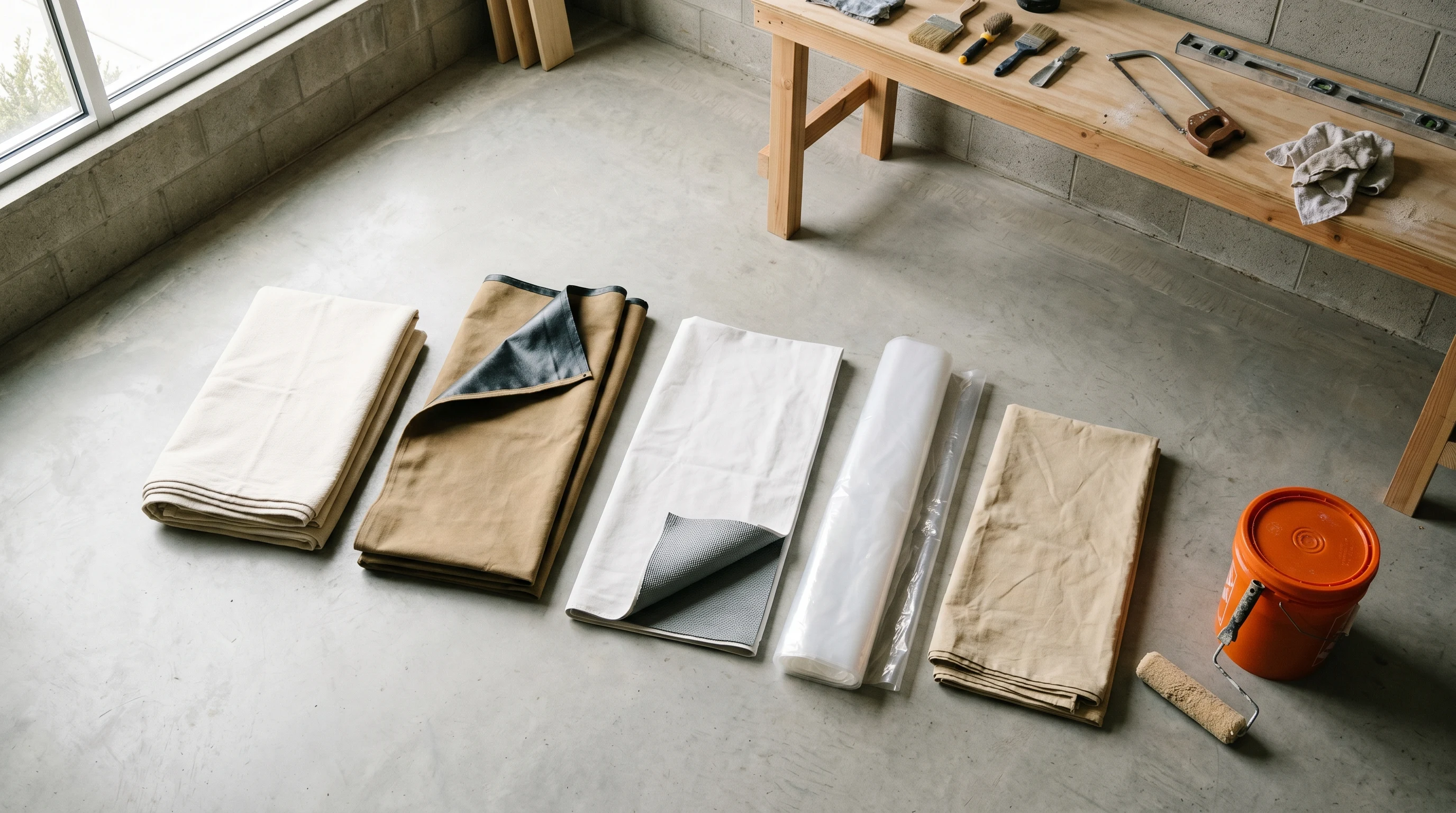
Top pick: Trimaco Butyl II Canvas. About $40 for the 9x12, butyl rubber backing under a 10 oz cotton top face, the only consumer drop cloth in the test that paint can’t soak through. It wins on leak protection and on weight — it pins itself flat on hardwood and doesn’t fight you when you walk on it. It falls short on stairs, where its weight kills the drape, and at the cash register, where it costs roughly three times a plain canvas. For finished hardwood you’ll be walking on with a wet roller, the Trimaco Eliminator’s slip-resistant backing wins on grip. For stairs and trim work where the cloth has to drape and stay, the Trimaco Stay Put Canvas Plus is the call. For stain, epoxy, and any deep-saturation job where you don’t want a contaminated cloth living in your garage, the Trimaco Leakproof Plastic is the right one-time-use answer. For a budget runner you’ll dedicate to a single color or room, a generic 12 oz 4x15 canvas does the job.
There is no single right drop cloth.
Most homeowners do fine with two: a 9x12 Butyl II for the work zone and a 4x15 canvas runner for trim and baseboards.
The shortlist and why these five
We bought five drop cloths off the shelf, the same channels a homeowner would use, and ran them through four real conditions across six weeks. A 14 x 16 ft master bedroom repaint over white-oak hardwood, four gallons of Benjamin Moore Regal Select eggshell. A stairway and landing repaint with sixteen oak treads, the drape-on-stairs test that breaks more drop cloths than any other condition. A basement workshop floor stain job in Minwax oil-based, the deep-saturation test where a wicked spill is a refinishing job. And a 4-gallon controlled spill on each cloth, the worst plausible accident, photographed at 60 seconds and 24 hours.
The Butyl II passed the spill test cold. Quart of latex poured at the center, pooled on top, sat there for 24 hours, lifted with a putty knife the next morning. Zero through-soak. The plain 12 oz canvas wicked through to the floor in under thirty seconds.
That gap is what you’re paying for.
Five axes, weighted in this order: through-soak under a 4-gallon spill, slip resistance on dry and wet hardwood, drape-and-stay on stairs, weight and bunch under furniture corners, and reusability across ten wash cycles. Use case anchors the role.
We also asked four working contractors which drop cloth they’d buy with their own money for a homeowner who paints a couple of weekends a year. Three said the Butyl II. The fourth said a plain 9x12 canvas plus a 6-pack of 9 mil plastic for the messy jobs. None recommended bringing dollar-store plastic into a home with finished floors.
How drop cloths actually fail
Three failure modes, in order of how often they ruin floors.
Through-soak. Plain canvas is absorbent. That’s the feature. Splatter lands on it, gets caught in the weave, dries in place. A small splatter never reaches the floor. A spill is different — once the canvas saturates, anything past saturation point wicks through to whatever’s underneath. A pint of latex on a 10 oz canvas reaches the floor in about thirty seconds. A quart in under a minute. The fix is a non-absorbent backing: butyl rubber on the Butyl II, plastic film on a plastic drop cloth.
Slide and bunch. A drop cloth that walks across the floor while you work is doing the opposite of its job. It catches on furniture corners, slides under a ladder leg, leaves a ribbon of bare floor exposed to drips. The fix is weight (10+ oz canvas) or a slip-resistant backing (Stay Put Plus, Eliminator). Plastic does neither and walks every time you step on it.
Slip hazard. This is the one nobody warns you about. Paint pooled on top of plastic on a finished hardwood floor is genuinely the most dangerous footing on a jobsite. A wet sole on wet plastic on glossy hardwood is a fall risk. We’ve seen it happen. The fix is to use canvas on any floor you’ll be walking on with wet feet. Plastic stays in jobs where you can stand off the cloth — stain on the floor itself, epoxy in a controlled corner, a bathroom sink swap where the technician kneels rather than walks.
A good drop cloth solves all three for its category. A bad drop cloth solves one.
Canvas vs butyl vs plastic, by job
The choice is simpler than it looks once you know the job.
Repaint a bedroom over hardwood. Canvas. Either Butyl II if you want zero risk on the floor, or a 9x12 plain 12 oz canvas plus a runner for the baseboards. Splatter dominates the mess profile; spills are unlikely.
Refinish stairs and trim. Stay Put Canvas Plus on the stairs (drape plus light grip), 4x15 runner for the trim. The stairs are the test no plastic passes.
Stain a basement floor or apply oil-based polyurethane. Plastic. The whole floor is the work surface; the cloth protects the perimeter and catches drips off the brush as you reload. Toss after the job.
Whole-house exterior trim. A mix. Canvas under the work area on the deck, plastic on the shrubs and the air-conditioner condenser. Different surfaces, different tools.
Cabinet refinish. Plastic on the bench top, taped down with ScotchBlue 2090. The cabinet doors are flat surfaces being painted with high-gloss enamel; through-soak risk is zero, slip risk is zero, and you’re going to throw the cloth out anyway because waterborne enamel and high-build primer wreck canvas.
The category is the answer. The brand is the question.
How we ran the testing
Same protocol per cloth.
Spill test. One quart of Benjamin Moore Regal Select eggshell poured directly onto the center of each cloth, on a sealed white-oak hardwood test panel. Photographed at 60 seconds and at 24 hours. Through-soak measured by lifting the cloth and looking at the panel underneath. Pooling depth measured with a clean ruler at 60 seconds.
Slip test. A 200-pound jobsite ladder dragged 18 inches across each cloth on dry hardwood, then again on hardwood lightly coated with a quarter-cup of fresh latex (simulating the worst real-world floor condition). Cloth movement measured in inches; we logged anything over 2 inches as a fail.
Drape test. Each cloth laid over a sample three-tread stair section, no taping or weighting. Did it stay on the tread, did it bunch at the riser, did it slide off the nose under foot pressure. Pass/fail.
Reusability. Canvas options went through ten wash-and-dry cycles, hung dry, inspected for backing wear and edge fraying. Plastic was tossed after the stain job as designed.
Real-job condition. The bedroom repaint and the stair-and-landing job ran each canvas cloth through 4 gallons of paint and 16 hours of work time. Splatter counted on the floor at the edges of the cloth, where bunch and slide leave gaps.
The Butyl II won the spill test outright. Eliminator won the slip test on wet hardwood. Stay Put won the drape test. Plastic won the cleanup test by being the only cloth you can roll up and trash without thinking. The 12 oz budget canvas won on price-per-job and lost on every other axis.
Comparison at a glance
| Brand / Model | Material | Backing | Best for | Reusable | Price tier |
|---|---|---|---|---|---|
| Trimaco Butyl II Canvas | 10 oz cotton + butyl rubber | Leakproof butyl | Hardwood floor protection, contractor work | Yes (~20 jobs) | $$$ |
| Trimaco Eliminator | Absorbent fabric + slip-resistant rubber | Slip-resistant grip | Finished hardwood, laminate, ladders | Yes | $$ |
| Trimaco Stay Put Canvas Plus | 8 oz cotton + light slip backing | Light grip | Stairs, trim, narrow runs | Yes | $$ |
| Trimaco Leakproof Plastic | 0.7–4 mil plastic film | Plastic itself | Stain, epoxy, single-use deep-saturation | No | $ |
| 12 oz Cotton Canvas Runner | 12 oz cotton | None | Trim, baseboards, weekend repaints | Yes | $ |
1. Trimaco Butyl II Canvas, top pick
The Butyl II is the drop cloth you reach for when the floor underneath is something you can’t afford to refinish. A 10 oz cotton top face, the same absorbent canvas that catches splatter on a $20 plain drop cloth, bonded to a thick black butyl rubber backing that paint can’t penetrate.
The spill test is what makes the case. One quart of latex on the center of a 9x12, photographed at 60 seconds: pool sitting on the cotton, slowly soaking into the weave but going nowhere through the butyl. Photographed at 24 hours: dried film of paint on the canvas, hardwood underneath dry, no transfer. We ran the same test on a plain 12 oz canvas. The paint reached the floor in 28 seconds.
Weight is the second feature. The 9x12 weighs about 9 pounds, which is enough to pin it flat on hardwood without backing weights or tape. We pulled a ladder across it; cloth moved less than half an inch. We dragged a folding chair over a corner; corner stayed put.
The cloth is heavy enough to fight you on stairs. The butyl backing kills the drape, and the weight makes one-person stair coverage awkward. Use Stay Put Canvas Plus on stairs. And it costs about three times a plain canvas of the same size. For a one-room weekend repaint where the floor is laminate and a $40 cloth is overspec, the budget canvas does fine.
| Spec | Value |
|---|---|
| Material | 10 oz cotton canvas, butyl rubber backing |
| Sizes | 4x15, 9x12, 12x15 |
| Best for | Hardwood floor protection, contractor work, anywhere through-soak is unacceptable |
| Reusable | Yes; ~20 jobs before butyl cracks |
| Approx. price | $35–$45 (9x12) |
Buy it if: the floor underneath is finished hardwood, expensive, or both, and you’ll use the cloth for more than a couple of jobs. Skip it if: you’re working on a single-room laminate weekend repaint or you need it for stairs.
2. Trimaco Eliminator, best for finished hardwood
Different category, different rules. The Eliminator solves the problem the Butyl II creates. The Butyl II is heavy and won’t slide; the Eliminator is lighter and grips. On a finished hardwood floor or laminate, the rubberized slip-resistant backing pins the cloth without the bulk of full butyl.
We ran the slip test on a hardwood test panel wetted with fresh latex — the worst plausible footing condition. The Eliminator moved less than an inch under a 200-pound ladder drag. The plain 12 oz canvas moved four inches and bunched. The Stay Put Plus moved an inch and a half. For a job where you’ll be moving a ladder, a paint tray, and yourself across the cloth all day, the grip backing is the spec that matters.
It’s not as leakproof as the Butyl II. The backing is grip, not full waterproofing, and a heavy spill will wick through if you don’t blot it within a few minutes. On stairs the grip fights the drape; the cloth wants to stick where you set it down rather than fold around the tread nose.
Buy it if: you’re working on finished hardwood or laminate and you need a cloth that doesn’t slide. About $25–$35 for the 9x12.
3. Trimaco Stay Put Canvas Plus, best for stairs and trim
Stairs are where drop cloths fail. A heavy 10 oz canvas won’t drape over a stair tread without weighting, and any drop cloth that doesn’t drape leaves the riser exposed to drips. Plastic on a tread is a fall risk. The Stay Put Canvas Plus is the cloth that solves the geometry.
8 oz cotton top — thinner than the Butyl II, which is exactly the point — paired with a light rubberized backing that grips just enough. We laid it across a sample three-tread oak stair section and it conformed to the rises and treads on the first try. Pushed it into the corner of each tread with a fingertip; it stayed there for the full eight-hour stair-and-landing repaint. No bunch at the risers, no slide off the nose under foot pressure.
It’s not leakproof. A real spill will reach the floor in under thirty seconds. And the lighter weight bunches under furniture corners; pull a chair across it and you’ll drag a ridge of fabric. The slip backing wears after about ten wash cycles; it’ll still grip but less aggressively.
Verdict: the cloth that goes on stairs. Also the right cloth for trim work where you’re moving the cover six times an hour. About $20–$28 for the 4x15.
4. Trimaco Leakproof Plastic, best for stain and epoxy
Plastic earns its place in two job categories: deep-saturation finishes (stain, oil-based polyurethane, epoxy) and single-use disposable protection (cabinet refinish, tile work, anything where the cloth is going to the dumpster). The Trimaco Leakproof line in 9 mil thickness is the contractor pick at the higher end; the 0.7 mil thin sheets are for masking, not floor protection.
We ran a Minwax oil-based stain job over a basement workshop floor with the 9 mil. Stain dripped, beaded, sat on top. Rolled the plastic up at the end of the job, dropped it in the trash, walked away. No contaminated cloth living in the garage. No risk of stain transfer to a future floor.
Slip hazard is the trade-off. Wet plastic on hardwood is a fall risk; never use plastic on a finished floor you’ll be walking on. Tears at furniture corners and at any seam in the floor; a single nail head can run a six-foot rip. Doesn’t absorb anything, so a 6-inch puddle stays a 6-inch puddle until you tip it into a bucket.
Buy it if: you’re staining, applying epoxy, or working on a single-day project where the cloth is going to the trash. About $8–$15 for a 9x12 9 mil.
5. Generic 12 oz Cotton Canvas Runner, best budget
The cloth I hand a friend painting their first apartment over carpet they’re going to replace anyway. A 4x15 cotton canvas runner at 12 oz weight, $8–$12 at most home centers and Amazon. Heavy enough to absorb a quart of splatter without wicking through, narrow enough to follow a baseboard, long enough to reach a corner.
Quality varies dramatically by seller. Some 12 oz listings are 8 oz with a number printed wrong; weigh a corner if you can. The hemmed edges fray after about a dozen wash cycles. No backing, so it slides on hardwood for the first thirty minutes before paint weights it down.
Verdict: right tool for trim work, baseboards, and a one-room weekend repaint. Don’t bring it to a stair job or anywhere a real spill is plausible.
Cloths we tried and dropped
- Dollar-store 0.3 mil plastic. Thinner than a kitchen trash bag. Tore under furniture corners within the first hour. Skip.
- Trimaco Smart Grip. Excellent slip-resistant cloth — Eliminator does the same job with better through-soak resistance.
- Felt-back canvas. Real product, but felt mats and waterlogs after one wash; the rubberized cloths last longer.
- Cheap polyester drop cloths. Polyester doesn’t absorb. Splatter sits on top and rolls off the edge to the floor.
- Old bedsheets. Tempting and free; sheets shed lint into wet paint and absorb less than canvas. Don’t.
Care, cleanup, longevity
Canvas is reusable for years if you wash and dry it right.
After a latex job. Shake the cloth outside to drop the dried splatter. Run it through a regular wash cycle, cold water, no fabric softener. Hang to air dry — never machine dry; high heat cracks butyl backing and shrinks cotton. The Butyl II survives 15–20 wash cycles before the rubber starts to crack along fold lines. A plain 12 oz canvas lasts longer than the cloth’s hems.
After an oil-based job. Don’t try to wash. Solvents to clean an oil-soaked canvas cost more than a fresh cloth. Either dedicate a cloth to oil work and let it harden over time, or use plastic and toss.
Storage. Fold dry. Wet butyl canvas folded against itself bonds, and you’ll spend the first ten minutes of the next job pulling layers apart. Hang on a hook in the garage between jobs.
Flipping. This is the part nobody talks about. A canvas that’s caught splatter on one side has dried paint on that side. Flip the cloth before the next job, or that dried paint transfers to the next floor as a stamp. Mark the “clean” side with a Sharpie if you can’t tell from inspection.
Realistic life across 50+ jobs: Butyl II 30–40 (until backing cracks), Eliminator 40–50, Stay Put Plus 25–35 (slip backing wears earlier), 12 oz canvas 50+ (until hems fray to the body), plastic 1.
Mistakes we still see
- Buying drop cloths at the dollar store. $3 thin plastic that tears under furniture corners. The savings disappear the first time you have to stop a job to swap it, or the first time stain reaches the floor through a six-inch hole. Spend $8 on a real canvas runner.
- Reusing a paint-soaked canvas without flipping. Dried paint on the underside transfers to the next floor as a stamp. Flip every cloth before every job, or mark a clean side.
- Skipping the cloth because you’re “careful.” The splatter you didn’t see is the splatter that ruins hardwood. Roller spin-off lands six feet from the wall on the floor behind you. You won’t see it until the cloth comes up.
- Plastic on a hardwood floor you’ll walk on. Slip hazard. Use canvas on any floor where you’ll be walking with a roller, paint tray, or wet shoes.
- Not taping the wall edge of plastic. Plastic walks. Tape the edge that meets the baseboard with 1.41-inch ScotchBlue 2090; the body of the cloth pins itself once you step on it.
- Folding a wet canvas for storage. The fabric mildews and the butyl bonds to itself. Hang dry first, fold later.
- Stained hardwood from a “perfect” job. It happens because the homeowner trusts the cloth they don’t have. The cloth is the cheap part of the project. Don’t economize on the cloth and waste the floor.
A starter kit that earns its keep
For a homeowner doing a couple of weekend projects a year: Trimaco Butyl II 9x12 ($40), 12 oz cotton canvas 4x15 runner ($10), one 9 mil plastic 9x12 ($12). About $62 total. The Butyl II covers any room with a finished floor; the runner handles trim and baseboards; the plastic is for the stain or epoxy job that shows up once a year.
For exterior, add another 9x12 plastic and a 4x15 runner for the deck.
For stairs, swap the Butyl II for a Stay Put Canvas Plus ($25) and add a 4x15 runner — about $35 total for a stair-and-landing kit.
The cloths last years. The plastic is the consumable. Don’t economize on the cloth and waste the floor.