How to Repaint Multiple Rooms Fast (Flip + Rental Playbook)
Batch the work. Three bedrooms, two days, three colors total. The order of operations that saves a full day per room on a flip or move-in repaint.

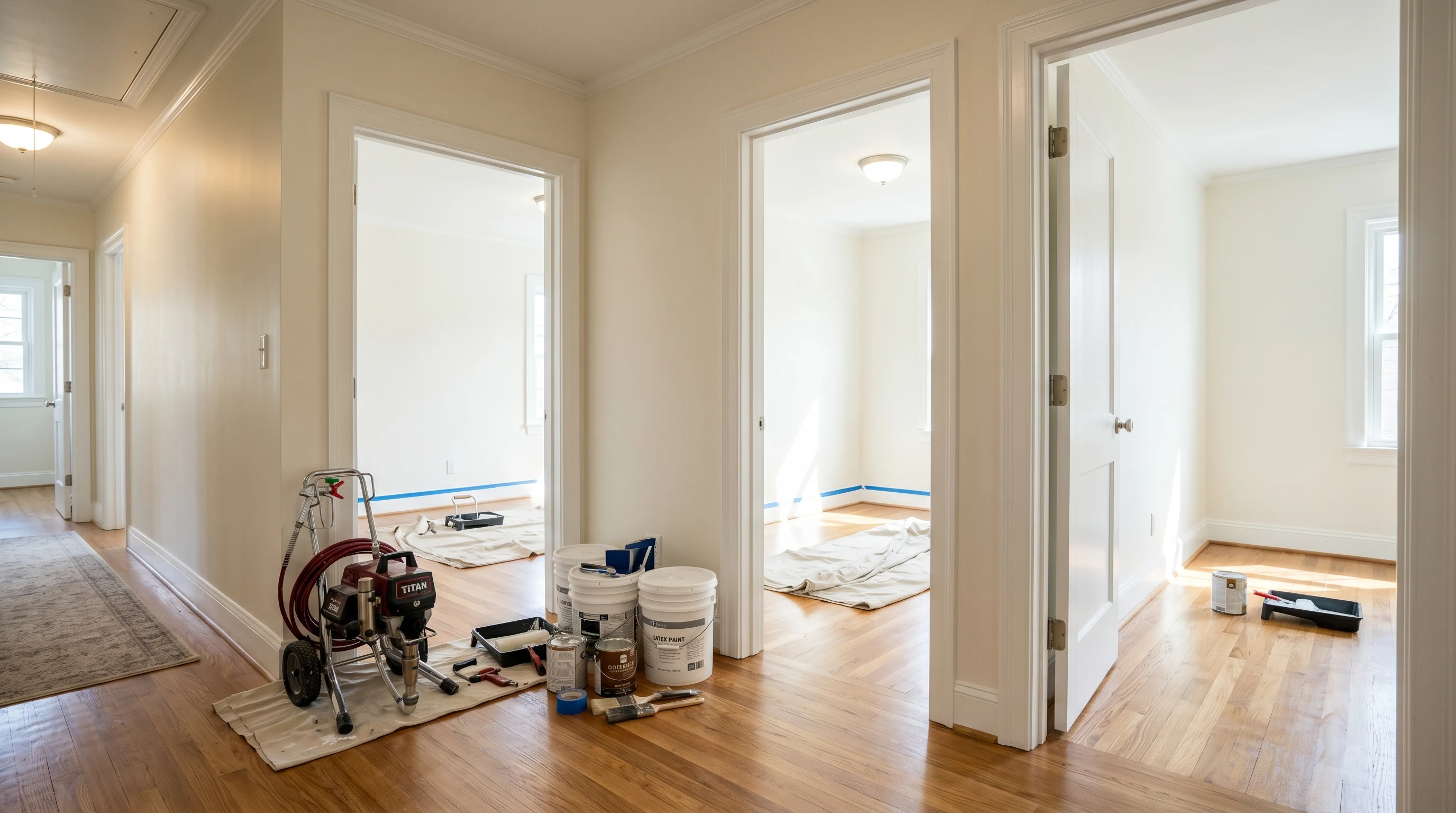
Okay, so you’ve got three bedrooms to repaint. Maybe it’s a flip, maybe it’s a rental between tenants, maybe you bought the house last week and the previous owner liked apricot. Whatever the reason, you don’t have three weekends. You have one.
Here’s the thing. The time-saving secret in a multi-room repaint isn’t a faster roller or a more expensive paint. It’s batching. Every drop cloth gets laid in one pass before you open a single can. Every ceiling gets sprayed before any wall gets touched. Every wall gets painted before any trim. Cut setup and breakdown by half, and three bedrooms collapses into a long weekend.
What you’ll get
Three bedrooms repainted (ceilings, walls, trim) in two to three days, for around $380 in paint and supplies. A contractor charges $1,200–$2,000 for the same job in the same time.
Honest take on time and cost
| Method | Active time (3 bedrooms) | Total elapsed | Skill |
|---|---|---|---|
| All brush + roll | 25–30 hrs | 3 weekends | Easy (slow) |
| Sprayer for ceilings + walls, brush trim | 8–10 hrs | 2 days | Medium |
| Same-color refresh, one coat, sprayer | 5–6 hrs | 1 long day | Medium |
Most flippers spray. A 12x12 bedroom ceiling brushed and rolled is 90 minutes of active work; sprayed and backrolled it’s 15. Multiply by three rooms and the sprayer bought you back a full day.
Cost for three bedrooms: about $300 in paint (one 5-gallon bucket of ceiling white, one 5-gallon bucket of wall color, one gallon of trim semi-gloss) plus $80 in supplies. Sprayer rental adds $60. The Graco Magnum X5 itself runs around $400 if you’d rather own it; one flip pays for it.
The three-color rule
Twelve-color flips don’t exist outside Instagram. Pick three colors for the whole job:
- One ceiling white, flat and cheap, the same in every room.
- One wall color — usually a soft warm white or a neutral greige. If you want some variation, pick two safe complementary neutrals and stick to those.
- One trim white in semi-gloss, every baseboard and door casing across all rooms.
Three colors means three cans you can carry around all weekend. Three SKUs you can match in five years for a touch-up. Twelve cans means you spend Sunday morning looking for the lid of the green that goes in the kid’s room.
The safest 2026 wall color for a rental or flip is still a warm white in the BM OC-17 / SW Alabaster range. It photographs well, doesn’t fight buyers’ furniture, and covers in one coat over most existing colors. The bathrooms get a different SKU because of moisture (see the bathroom paint round-up), but the color can match the rest of the house.
Pick a fast-recoat paint
The second thing that buys you time is recoat window. Different wall paints vary wildly:
- Behr Marquee. 30 minutes to recoat in dry weather. Same-day second coat.
- Behr Premium Plus. 1 hour to recoat. Same-day second coat.
- BM Premium Plus. 1 hour in dry weather.
- Sherwin SuperPaint. 4 hours. One coat per day if you start at noon.
- BM Aura. 4 hours, but covers in one coat on most walls.
For a flip, Behr Marquee or Premium Plus is the right call. The 30-minute recoat means you spray the second coat across all three bedrooms before lunch and have trim done by dinner. Save Aura for your own house.
Spray ceilings and walls, brush trim
The Graco Magnum X5 is the sweet spot for whole-house DIY. It pulls paint straight from the bucket through a suction tube and pushes it through the tip at 3,000 psi. Ten minutes of practice on cardboard and you can lay down a smooth even coat. See our paint sprayer round-up for the full picks.
If you’ve never used a sprayer, this isn’t the day to learn. Rent the airless on day two after you’ve practiced on the garage. First-time spray on a real wall produces drips, runs, and dry spots, and there’s no fixing them once the second coat goes on.
The trick that makes a sprayer finish look hand-rolled is backrolling. After spraying a wall section, run a 9” microfiber roller over the wet film immediately. The roller texture matches the rest of the wall and hides the slight orange-peel sheen of pure spray. Two people are faster (one sprays, one backrolls), but one person can do it in 6-foot sections.
Trim still gets brushed. Spraying trim means masking every wall again, and you’ve already painted the walls.
The edge trick that saves an hour per room
Cutting in by hand at the wall-ceiling line is the slowest part of a careful repaint. On a flip, skip it. Here’s the sequence:
- Run a thin bead of paintable caulk along every wall-ceiling joint and every wall-wall corner where the existing line is rough. Smooth with a wet finger. Skin time, 30 minutes.
- Spray the ceiling. Let the overspray drift down onto the top inch of the wall. It doesn’t matter; you’re about to paint that wall.
- Spray the walls. Minor overspray on the ceiling edge dies into a clean line because the caulk gave you a perfect joint to spray against.
- Walk back with a 2.5” brush and the wall color, touching up any place the ceiling spray landed an obvious line.
Caulk plus careful sequencing replaces 90 minutes of taping and hand-cutting per room with 15 minutes of caulking and a 5-minute touch-up walk. On three rooms, that’s four hours back.
Skip the heavy prep
You don’t need TSP unless the walls are visibly greasy (kitchens, smokers’ rooms). On normal residential walls, a damp microfiber wipe is enough. TSP adds two hours per room you don’t get back.
You also probably don’t need primer. If the existing paint is sound (no peeling, no stains, no smoke film) and you’re going color-on-color or color-to-white, two coats of self-priming wall paint covers without a separate primer step. Spot-prime stains with Zinsser BIN. A full prime coat across three bedrooms is a wasted day.
The fastest possible repaint is a same-color refresh. If the previous owner left you the SKU and the existing color is acceptable, you skip primer, you usually only need one coat (sometimes two on heavily marked walls), and the wall paint blends seamlessly with itself even where you stop and start. If you can pull this off, three bedrooms is a one-day job.
Day-by-day flow
Day 1: prep all three rooms, no painting
Move everything to the center of each room. Drape with plastic. Fill nail holes with lightweight spackle in every room before you sand any of them. Patch all of room A, all of room B, all of room C, then sand all of A, all of B, all of C. The motion of “patch one room then move on” doubles your trips up and down the hall.
Tape the ceiling-wall joint in every room. Tape baseboards. Run plastic sheeting across all three floors as a continuous run from the hallway in. Don’t break the plastic between rooms; you’ll be walking the sprayer hose through the doorways.
End of day 1: every room is masked, patched, and ready to spray. You haven’t opened a can.
Day 2: ceilings in the morning, walls in the afternoon
Mix the 5-gallon ceiling bucket. Set up the Magnum X5 in the hallway, suction tube into the bucket. Pull the gun and hose into the first bedroom. Spray the ceiling in 6-foot sections, backrolling immediately with the 9” microfiber. Move to the next room. Then the next. Forty-five minutes per ceiling on a 12x12 room with 8-foot ceilings.
Let ceilings flash off (30 minutes for Marquee, an hour for most). Switch the suction tube to the wall-color bucket. Reload the gun. Spray walls, room by room, same backroll. On Behr Marquee or Premium Plus, the second coat goes on the same afternoon.
End of day 2: ceilings and walls done, two coats. Trim is all that’s left.
Day 3: trim and touch-ups, half day
Pull all the tape slowly, while the wall paint is still slightly tacky. A clean tape pull is the difference between a flip job and a contractor job.
Brush trim with the gallon of semi-gloss. Baseboards, door casings, window casings. Splatter onto the wall is fine; you’re going to walk back with a small brush and the wall color and dab the dots out.
Final walk: every room, with a quart of the wall color and a 1” brush, looking for splatter, missed cuts, and tape marks. 20 minutes per room and every room looks finished.
Pull plastic, fold drop cloths, vacuum. Done.
Common time-wasters to skip
- Taping every door frame. Brush around it carefully. Tape on a flip costs more time than it saves on trim that’s about to get brushed anyway.
- Painting trim before walls. Wall paint splatters onto fresh trim and forces a redo. Trim is always last.
- Perfectionism. You’re selling, not living. The buyer doesn’t see the slight roller texture three feet up; they see clean walls and crisp trim. A 96% finish is a sold house.
- Hand-cutting lines no one looks at. The top of a closet wall, the wall behind a bedroom door, the strip below a counter. Skip the careful cut, accept the overspray, save the hour.
- Premium paint on a flip. Aura at $80/gallon is a wasted $40 on a wall the next owner will probably repaint in their own color anyway.
Common mistakes
- Spraying without backrolling. The wall ends up with a slight orange-peel texture that doesn’t match patched repairs. Always backroll.
- Pulling tape too late. Once the wall paint is fully cured (24+ hours), it pulls in chips with the tape. Pull while slightly tacky.
- Mixing two cans of the same color from different lots without boxing. Same SKU, same store, two cans bought a week apart can read slightly different. Pour them together in a 5-gallon bucket before you start spraying. The pros call this boxing, and it stops a visible color shift from landing in the middle of a wall.
Cost — 3-bedroom flip
| Item | Cost |
|---|---|
| 5-gal bucket Behr Marquee or BM Premium Plus (walls) | $180 |
| 5-gal bucket ceiling white | $90 |
| 1 gal semi-gloss trim white | $40 |
| Plastic sheeting (12’x400’) | $30 |
| Frog Tape (2 rolls) | $20 |
| Microfiber roller sleeves (6-pack) | $15 |
| Caulk (4 tubes) | $20 |
| Sprayer rental (1 day) | $60 |
| Total | ~$455 |
Pro repaint of the same three bedrooms runs $1,200–$2,000 depending on city. A weekend of your time is what closes the gap, and you have to know how to run the sprayer.
Maintenance
Mid-grade wall paint in a flip lasts 5–7 years before the next owner repaints. Save a labeled quart of each color in mason jars; gallon cans rust at the rim within a year. Note the SKUs in the disclosure packet. Buyers ask, agents ask, and a five-minute touch-up at year two is worth the paint chip.
If you flip the same neighborhood repeatedly, build a kit: one 5-gallon bucket each of your standard wall white and ceiling white, kept sealed in a climate-controlled space. By flip three you’re not buying paint, just supplies. The math gets even better.