Painting Interior Brick: Fireplaces, Accent Walls, and the White-Brick Question
Painting interior brick — fireplace soot, the whitewash decision, BIN shellac, and why this is the one room choice you can't undo. A sensory, prep-honest guide.

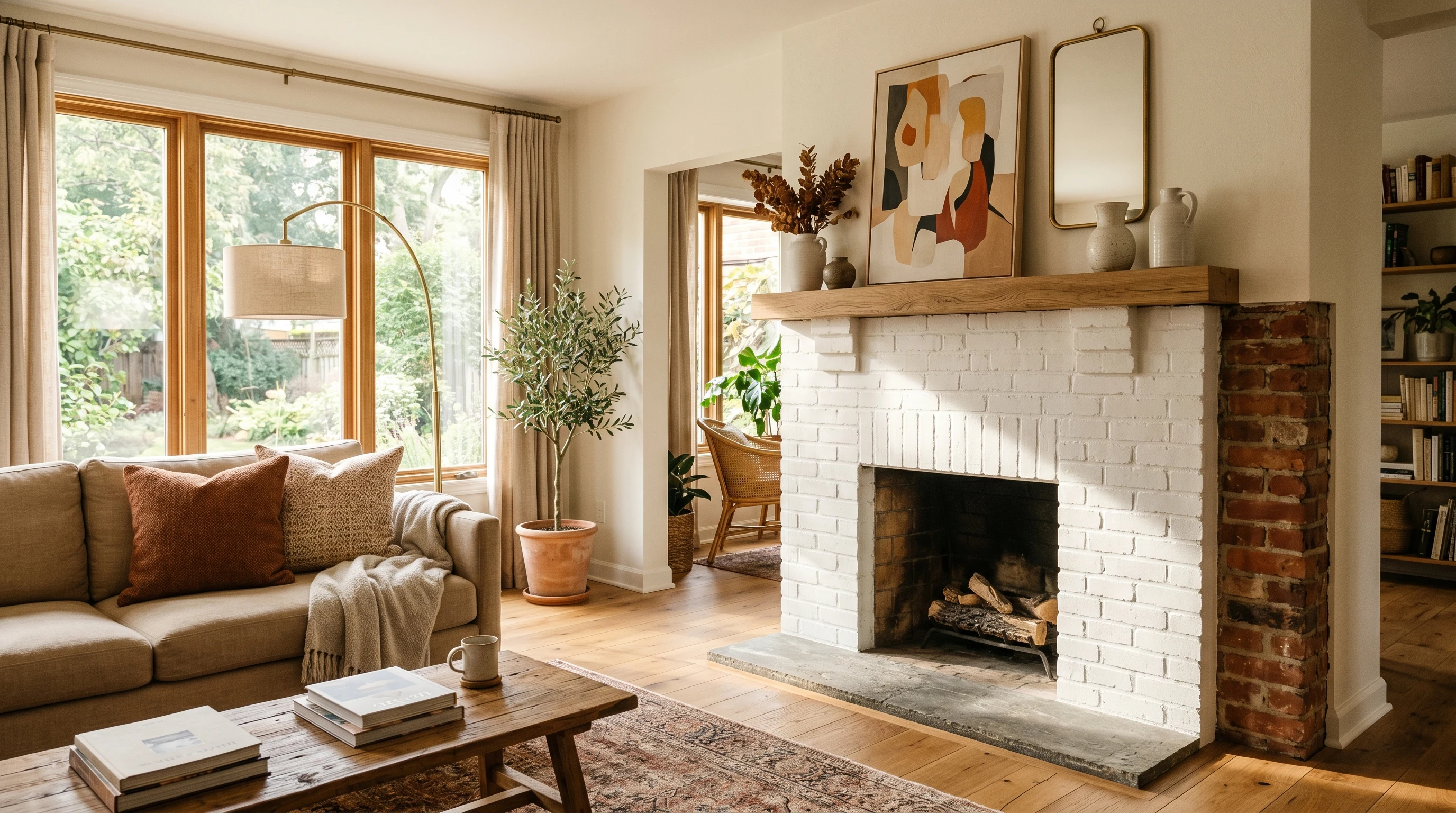
The brick reads warmer in afternoon than the chip suggests. That’s the first thing to know before you paint over it. Strip away the dust and look at it in late western light, then again at breakfast in the cool grey of north light, and decide whether the room actually needs the brick to be quieter, or whether you’ve just been seeing it badly.
TL;DR
- Decide first: painted brick is permanent. Sandblasting it back is rarely complete.
- Clean: vacuum, hand-brush soft mortar, TSP wash. On a sooty fireplace, also acid-wash.
- Primer: Zinsser BIN shellac for soot or smoke. Masonry bonding primer (Loxon, Aqua-Lock) for clean brick.
- Paint: premium interior acrylic. BM Aura Matte for the soft chalky look, Regal Select Eggshell for higher-traffic walls.
- Method: thick brush and 3/4-inch nap, two coats, or a whitewash that lets the texture read through.
- Cure: 30 days before a working fireplace runs hot against fresh paint.
- Skill: medium. The decision is harder than the work.
The decision before the prep
Most of what gets painted on the internet is photographed in golden afternoon light. Your living room isn’t lit that way at 7am in February. Before you commit, look at the brick at the hour you actually use the room. A red-brick fireplace that reads dated under noon overheads can read warm and held-together at 6pm in lamplight. The opposite is also true. A wall that charms in summer goes heavy and brown in January.
Painted white brick is a real and beautiful look. It’s also the only finish choice in this article you can’t take back. Sandblasting cured paint off porous interior brick takes days, makes a mess that gets into every adjacent surface, and leaves residual pigment in the brick face permanently. Limewash is reversible. Paint isn’t. Sit with the choice for a week.
The case for painting is genuine. Painted brick lets the rest of the room breathe. A fireplace that’s been visually shouting since 1978 can quietly recede. The case against is that you might miss the brick the first time the room fills with late sun and you remember what it looked like before.
Why interior brick is its own substrate
Exterior brick fights rain, freeze-thaw, and UV. Interior brick doesn’t. The variables here are different ones, and they reward a different prep.
Soot and creosote. A working fireplace surround that’s been used for thirty winters has soot baked into the brick face and creosote drift into the mortar. Surface cleaning lifts none of it. The stain is in the pores, and any latex primer you put over it will let smoke ghost through within a year.
Old mortar. The lime-based mortar in pre-1940 homes absorbs paint differently than modern Portland-cement joints. The joints often need their own primer pass and a second look on the finish coat. They suck up paint while the brick faces still look damp.
Heat near the firebox. Surface temperatures within six inches of a working firebox opening can hit 200°F during a long burn. That’s inside the spec for any quality interior acrylic, but only after a 30-day full cure. Light a fire on green paint and you get blistering in the first week.
Aesthetic permanence. The substrate doesn’t fail you here. Your taste does, on a five-year arc. Mention it to yourself out loud.
Step 1: Vacuum, brush, and degrease
Shop-vac the brick face from top to bottom with a brush attachment. Get into every mortar joint. A wall that hasn’t been touched in years is holding fine masonry dust the topcoat will not stick to. Then walk the wall with a stiff hand wire brush. Loose mortar comes off, soft pointing flakes free, and you find the joints that need repointing before you commit to paint.
For a fireplace surround, follow with a TSP wash. A tablespoon per gallon of warm water, sponge it on, rinse with clean water, and do it twice. The first pass pulls smoke residue. The second confirms.
If the brick around the firebox reads black or dark grey rather than its native color, you have soot embedded in the pore structure. Mix a 1:10 muriatic acid solution (acid into water, never the reverse), brush it onto the discolored zone with a synthetic brush, let it fizz for two minutes, and rinse heavy with clean water. Neutralize the rinse runoff with a baking-soda solution if it touches anything you care about. Then dry the wall for 48 hours with a fan running. Wet brick under primer is the most common cause of failure on this job.
Safety callout. Muriatic acid is corrosive and the fumes are aggressive. Chemical-resistant gloves, eye pro, N95 minimum, windows open, fan running outward. Don’t mix it with bleach. Don’t acid-wash a wall you can’t ventilate.
Step 2: Repoint and patch
Pack failed mortar joints with type-N mix. Rake out the bad section to a half-inch depth, mist lightly, pack new mortar in tight, strike to match the surrounding profile. Let new mortar cure 30 days before primer if you want a uniform finish. Fresh mortar prints through latex paint as a slightly darker rectangle for years.
Soft old lime mortar tells you with the wire brush. If a joint crumbles under hand pressure, it needs the work. If it holds, it’s fine to paint over.
Step 3: Prime
Two paths here, and they’re not interchangeable.
For a fireplace surround or any brick wall that’s lived through smoke: Zinsser BIN shellac primer. BIN is the answer for soot, creosote, smoke ghosting, water-soluble stains, and the tannin bleed you get from old timber framing exposed in factory-conversion lofts. Shellac seals what acrylic primers cannot. It dries in 45 minutes, recoats in an hour, smells strong while wet, and cleans with denatured alcohol. Two coats on a heavily sooted surround. One coat on lightly stained brick. Roll the field with a 3/4-inch nap; brush the joints first.
For clean interior brick that has never seen smoke: a masonry-bonding primer. Sherwin-Williams Loxon Concrete & Masonry Primer is the workhorse. INSL-X Aqua-Lock is the gentler waterborne option. Zinsser Cover Stain (oil) bonds beautifully if you don’t mind the cleanup. These are made for porous masonry and they breathe better than shellac, which matters slightly less indoors than out, but matters.
One thin saturating coat is enough on properly prepped brick. If the primer disappears in, do a second.
Step 4: Paint type
Any premium interior acrylic does the job over the right primer. Three I’d reach for first:
- Benjamin Moore Aura Matte for the soft chalky look most painted-brick photographs are showing you. Aura’s pigment load is high enough that the matte still wipes clean.
- Benjamin Moore Regal Select Eggshell for a wall that gets touched, brushed past, or that holds a TV mount.
- Sherwin-Williams Cashmere or Emerald as the SW equivalents. Emerald reads slightly cooler at the same nominal color.
Color-wise: warm whites read better on textured brick than cool whites do. The texture cools the read by half a step on its own, and a too-cool white goes blue-grey under afternoon shade. Simply White (BM OC-117), Swiss Coffee (BM OC-45), and Alabaster (SW 7008) are the three I keep returning to. White Dove (BM OC-17) reads slightly warmer still and sits beautifully against unstained oak floors.
Step 5: Apply, full opacity or whitewash
Two coats of full opacity is the default. Brush the joints first with a 3-inch synthetic, then roll the faces with a 3/4-inch nap. Don’t over-thin. The roller wants enough paint to fill the texture without drowning the joints. Sixteen hours between coats. Watch for holidays in raking morning light before you call the second coat done.
Whitewash is the alternative when you want the brick to keep speaking. Mix three parts paint to one part water in a clean bucket. Brush on one or two bricks at a time, then dab back with a damp clean rag while it’s wet, lifting paint out of the high spots and leaving it in the recesses. The brick character stays visible. The wall reads softer.
Whitewash is also forgiving of imperfect prep (soot bleed-through becomes part of the texture rather than a flaw), but it’s still worth a primer pass on a sooty surround. The smoke smell doesn’t seal itself.
Step 6: Cure
Touch-dry in two hours. Recoat in 16. Full cure runs 30 days, and on a working fireplace, that 30-day window matters. A long burn against three-week-old paint blisters near the firebox. Let the wall harden before you light a fire.
During cure, no aggressive cleaning, no lean-objects-against-it, no candles directly on the hearth pushing heat onto fresh paint.
Common mistakes
- Painting brick without ever cleaning it. Soot bleeds through. Loose dust kills adhesion. The two-hour cleaning step is the one that decides whether the job lasts a year or a decade.
- Using interior wall paint on the firebox interior. The surround handles regular acrylic. The firebox itself needs Rust-Oleum High Heat or equivalent rated to 1,200°F. If the firebox is functional, don’t paint inside it at all.
- Skipping shellac on a sooty surround. Latex primer over creosote ghosts back through in months. BIN is the only reliable seal.
- Whitewashing without testing on a hidden brick first. The dilution ratio that looks right on the can sometimes reads chalky on a particular brick blend. Test a square foot in a corner.
- Regretting it. The most common mistake. If you’re not sure on month one, you won’t be sure on month six. Sit with it.
Maintenance and longevity
Wipe with a damp microfiber. Don’t scrub a matte finish hard. A quality matte handles a soft wipe and not much more. Higher-traffic walls in eggshell take real cleaning.
Expect 10–15 years on an interior surround before any refresh, longer on an accent wall that doesn’t see smoke. The first failure mode tends to be peeling near the firebox if the cure was rushed, or smoke ghosting back through if the primer was wrong. Touch up small failures with the same can. Interior acrylics keep their color sealed for years if the can stays full.
Failure modes
Efflorescence bloom. White powdery deposits coming through the paint film mean trapped moisture. Sometimes it’s an exterior leak finding its way in; sometimes a chimney cap gone bad. The film comes off with the bloom. Diagnose moisture first; the /fix/concrete-efflorescence-floor page walks the test.
Peeling near the firebox. Almost always rushed cure. The 30-day window is non-negotiable on a wall that gets hot.
Smoke ghosting. Inadequate primer. Two coats of BIN, or strip and start the prime over. There’s no fix from the topcoat side.
If you’ve sat with the decision and you still want it painted, a fireplace surround in soft Aura Matte against a linen sofa at 5pm in October is one of the quieter, more held-together rooms a house can have. Just don’t decide in July.