Scrubbability vs Washability: What the Cycle Count on the Spec Sheet Actually Means
ASTM D2486 explained — how scrub cycles get measured, what Class I/II/III mean, and the cure-time and sheen catches that decide whether your wall paint earns its rating.

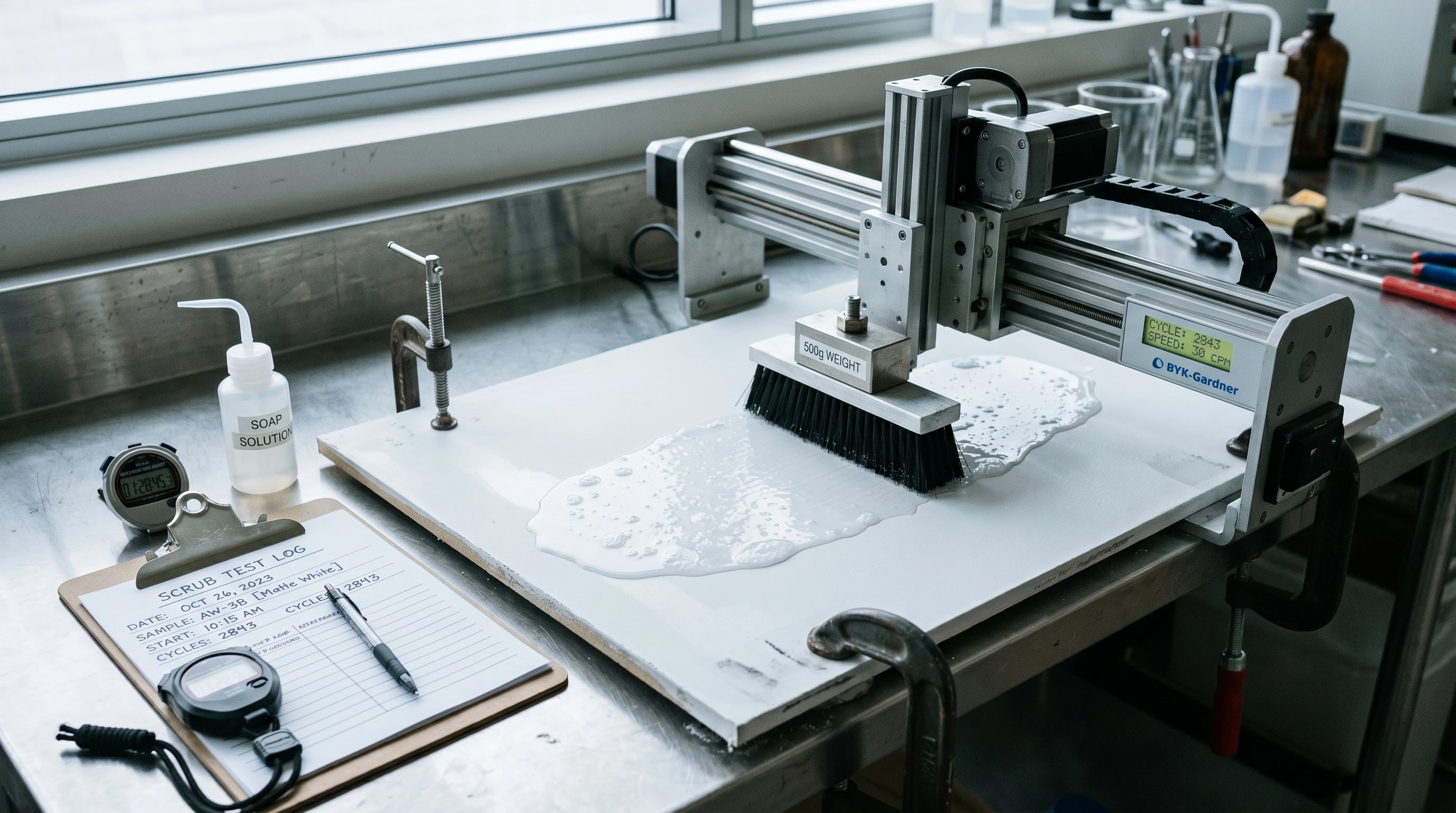
Most people never read the scrub-cycle line on a paint can, and the people who do tend to read it wrong. The number is real, the test behind it is well-defined, and the gap between a Class I paint and a builder-grade flat runs roughly two orders of magnitude on the same wall. That gap shows up the first time someone wipes ketchup off the kitchen wall and the matte halo travels six inches up from the baseboard. The reason comes down to one ASTM method, two variables the can doesn’t advertise, and a 30-day window most homeowners ignore.
The test behind the number
ASTM D2486 is the standard. A panel is drawn down at a controlled wet-film thickness, cured for the prescribed time (most labs run the full 7-day pre-test cure), and clamped flat in a Gardner-style scrub machine. A weighted brush with stiff nylon bristles rides a carriage that strokes the panel back and forth at a fixed rate. The brush is loaded with a standardized abrasive medium (the calcium-carbonate slurry specified in the method) and the surface is wetted with 0.5% Tide solution, refreshed periodically. A single cycle is one back-and-forth stroke. The test runs until the film breaks through to the substrate along a continuous line a tenth of an inch wide. That cycle count is the paint’s scrubbability rating.
Two things matter about the protocol. The brush is abrasive, not the soap. And the failure criterion is breakthrough to the substrate, not surface scuffing, not gloss change, not staining. The number on the can is how many wet abrasive strokes the film survives before it physically wears off the wall.
Class I, II, III, what the bands mean
The method itself doesn’t assign classes. The bands come from the federal product standards (Master Painters Institute and TT-P specs) that paint formulators write to, and the convention shakes out roughly:
| Class | Cycles to failure | Real-world reading |
|---|---|---|
| Class I | over 10,000 | Premium kitchen / bath; survives weekly wipe-down for years |
| Class II | around 5,000 | Quality wall paint; survives normal cleaning |
| Class III | 500 to 1,000 | Wipe-able once or twice; builder-grade flat |
| Below Class III | under 500 | Contractor flat for ceilings only |
A Class I rating is what “scrubbable” actually means as a technical claim. Class II is “washable.” Class III is the marketing word “wipe-able,” which is honest about what it is. Below 500 cycles is paint you stop touching after the brush leaves the wall.
What the brands actually publish
Pull the technical data sheet for any premium line and the scrub cycles are listed, usually under “ASTM D2486 Scrub Resistance.” Real numbers from current TDS publications and panel work, all measured at full cure on smooth primed drywall:
- Benjamin Moore Aura Interior, satin: 40,000+ cycles. Aura’s published lab data runs the test to 40,000 and stops without breakthrough on most sheens.
- Sherwin-Williams Emerald Interior, satin: 30,000+ cycles. Emerald’s denser binder surface is what earns this number.
- Behr Marquee, satin: 10,000 to 15,000 cycles. Solid Class I, and the reason Marquee shows up on every “best for kitchens” list.
- Behr Premium Plus, eggshell: 3,000 to 5,000 cycles. Mid-Class II. Fine for living rooms.
- Builder-grade contractor flat: 500 to 1,500 cycles. Class III, sometimes worse on the cheapest tier.
Two orders of magnitude separate the top and the bottom. The same wall painted with Aura satin versus a generic flat is not the same wall in any test that involves a damp cloth.
The 30-day catch
Cycle ratings are measured at full cure. Latex paint hits touch-dry in an hour and recoat in four, but the binder is not finished. Coalescence (the stage where the acrylic particles fuse into a continuous film) runs for hours. Cross-linking and final hardness development run for weeks. At 70 °F and 50% relative humidity, the canonical cure window is 28 to 30 days. Cooler or more humid rooms push it longer.
Scrub a Class I paint on day seven and the film comes off in sheets. The same paint on day thirty hits its rated cycles. This is the most expensive mistake on a fresh repaint: the toddler draws on the wall in week two, the parent reaches for a Magic Eraser, and the wall now has a dull patch the size of a paperback book. The film was still curing. The chemistry hadn’t finished.
If you have to clean the wall before day thirty, dab. Never scrub. Cool water, soft cloth, no detergent, no pressure. Treat it like a watercolor.
Sheen matters more than brand
Here is the part most homeowners get wrong: sheen affects scrubbability more than the brand does. Within the same product line, eggshell scrubs roughly 5 to 10 times more cycles than flat. Satin scrubs more than eggshell. Semi-gloss and gloss test off the top of the chart.
The chemistry is straightforward. Sheen is governed by the pigment volume concentration (PVC) of the cured film. Flat paints run high PVC, so pigment dominates the surface, which scatters light and gives the matte look. Higher-sheen paints run lower PVC, which means more binder per unit volume of film. Binder is what resists abrasion. More binder, denser cross-linked network, more cycles to failure. A high-grade flat at PVC near 50% will lose to the same brand’s eggshell at PVC near 35%, every time.
This is why a Class III flat in a kitchen feels like sandpaper after the first wipe-down. The pigment is at the surface; abrasion strips it; the underlying binder is exposed; the next wipe takes more pigment with it. Step up to eggshell at the same brand and the binder fraction at the surface is high enough to ride out the brush.
Where the number actually matters
Anywhere a damp cloth visits weekly. Kitchens get food splatter on the wall behind the range and around the trash can. Bathrooms get steam, soap film, and toothpaste. Kid bedrooms get crayon, fingerprints, and inexplicable smears at chair-rail height. Hallways get hand smudges at shoulder height and shoe scuffs at baseboard. Light switches and door frames get touched a hundred times a day. These zones need Class I or strong Class II.
Ceilings, formal living rooms, dining rooms, and most adult bedrooms get cleaned twice a year if at all. Class III matte is fine; Class II eggshell is overkill but harmless. The cycle count is solving a problem you do not have.
Common mistakes
- Specifying flat in a kitchen because flat hides imperfections. Both halves are true: flat hides drywall waves better than eggshell, and flat strips with the first damp wipe. Pick the wall you want. Smooth-looking on day one, or smooth-looking on day three hundred. For kitchens, that is eggshell or satin every time. Sand the wall flat, or accept the slight sheen.
- Assuming washable equals scrubbable. ASTM D4828 (washability) is a sponge test with mild soap. Almost every modern latex passes it. ASTM D2486 (scrubbability) is the abrasive nylon-brush test described above. The two words are not interchangeable on a spec sheet, and a “washable” claim is not a Class I claim.
- Believing lifetime warranty marketing. Lifetime warranties cover film defects: peeling, blistering, premature fade. Mechanical wear from cleaning is excluded in nearly every fine-print warranty document. The TDS scrub number is the warranty on washability. The lid sticker is not.
- Cleaning before full cure. The 30-day cure window is when the paint earns its rating. Day seven is too soon for any scrub-resistance claim, regardless of brand or class.
- Comparing scrub numbers across sheens. Aura matte at 8,000 cycles and Emerald satin at 30,000 cycles are not the same comparison. Match sheen to sheen. Different sheens within the same brand differ as much as different brands within the same sheen.
The cycle count on the back of the can is a real measurement of a real test. Buy the sheen and the class the room needs, give the film thirty days to finish, and the wall holds.