How Much Paint Do You Actually Need? Coverage Math, Explained
The 350–400 sq ft per gallon spec, what it really means at 4 mils wet, and how to translate it into the right number of gallons for your room or house.

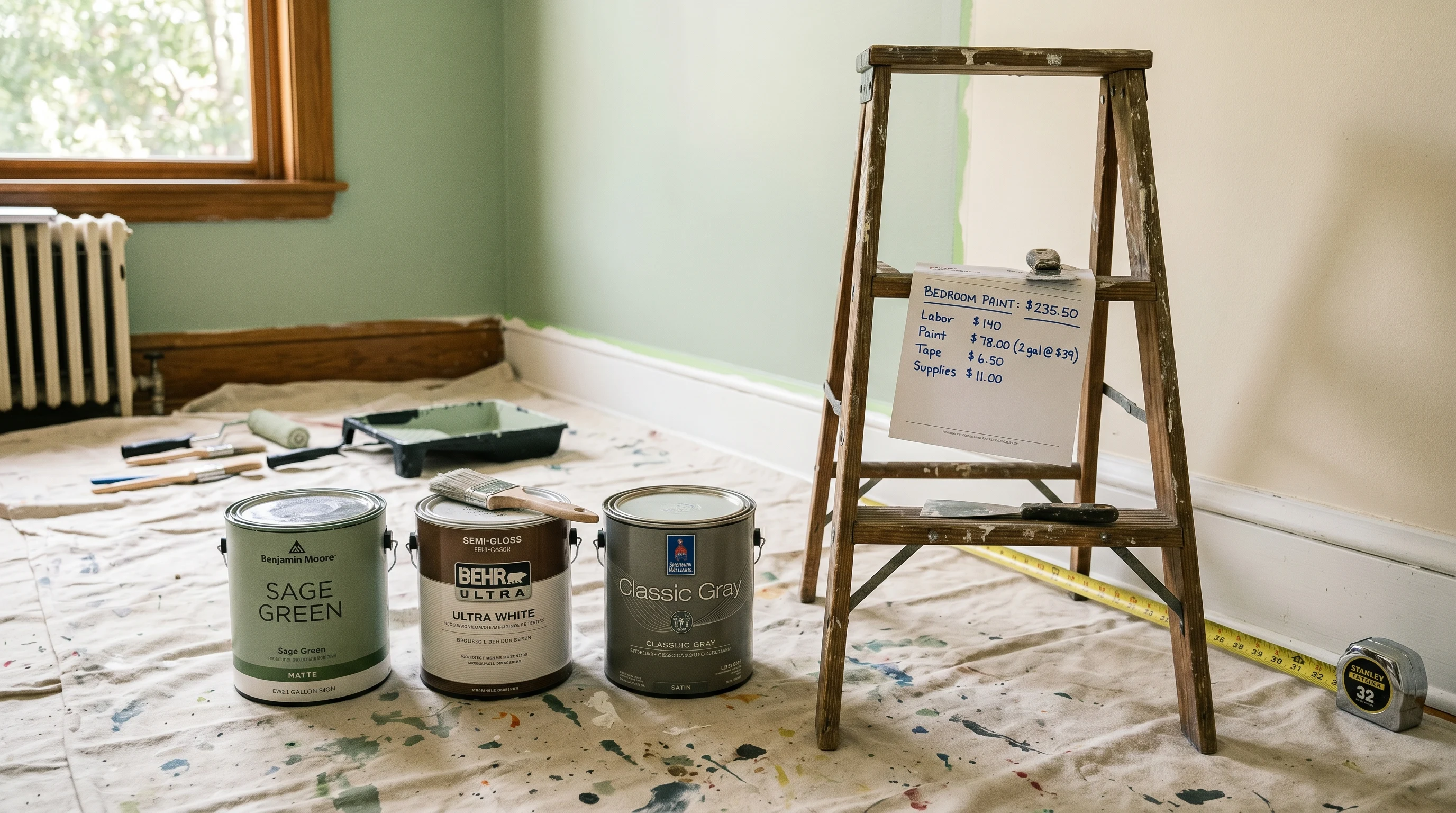
The can says 350–400 square feet per gallon. The wall on your living room doesn’t read the spec sheet. Spec coverage assumes a smooth, primed, lightly absorbent surface and a wet film of about 4 mils, which dries to roughly 2 mils once the water and coalescing solvents leave. Real walls absorb differently, real colors hide differently, and almost every job needs two coats. The reason for that gap is straightforward chemistry, and once you understand the math you can stop guessing at the paint store.
A mil is one thousandth of an inch. When a quality latex is rolled at 4 mils wet, the binder and pigment that stay behind form a continuous film about 2 mils thick, thick enough to hide the substrate but thin enough to cure without cracking. Push the wet film thicker and you get sags, mud-cracking on the second coat, and a slow cure that traps coalescing solvents. Roll it thinner and the pigment load drops below the threshold for opacity, which is why one heavy coat almost never looks like two normal ones. The film thickness governs the optics, and the can’s coverage spec is just the math working backward from a 2-mil dry target.
What real-world coverage actually looks like
The 350–400 sq ft number is a ceiling, not an average. Apply these factors to the spec coverage before you buy.
| Surface | Coverage factor | Effective sq ft / gal |
|---|---|---|
| Smooth primed drywall | 1.00 | 350–400 |
| Light-orange-peel drywall | 0.85 | 300–340 |
| Knockdown texture | 0.75 | 260–300 |
| Bare or sanded wood | 0.75 | 260–300 |
| Rough stucco | 0.55 | 190–220 |
| Concrete block (CMU) | 0.50 | 175–200 |
Texture multiplies the actual surface area you’re coating. A wall with knockdown adds about 20% to the geometric square footage because the paint has to wrap every peak and valley. Bare wood and unprimed drywall pull water out of the wet film faster than the binder can coalesce, so the first coat soaks in before it forms a continuous skin. CMU is the worst case. The hollow texture and high porosity together can cut coverage in half.
Primer math, separately
Primer is a different coverage line item, not a discount on topcoat consumption. A dedicated drywall primer like Zinsser Bullseye 1-2-3 typically covers 400–450 sq ft per gallon because the film is thinner and the formulation prioritizes adhesion over hide. A stain-blocking shellac primer (BIN, Cover Stain) covers similarly per coat, but water damage, smoke residue, and tannin bleed often need two passes to seal completely. Size primer by the symptom you’re solving, not by total square footage. One gallon of stain-blocker over a localized water stain is plenty; a full ceiling repaint after a smoke event needs the math run on its own.
Color is a coverage variable too
Going from white to a soft warm white is a one-coat-and-touch-up job. Going from white to a saturated navy is a different problem. Most brands tint deep colors into a clear or “deep” base that contains very little titanium dioxide, the white pigment that does most of the optical hiding. A deep base colored to a true black or saturated red can require three coats over a white primer to read uniformly under raking light. The fix most pros use is a tinted gray primer matched to the topcoat. Benjamin Moore Aura, Sherwin-Williams Emerald, and Behr Marquee all offer this option at the counter for a few dollars per gallon.
Same logic, smaller magnitude: any color shift greater than about 30 LRV points should be planned at two coats minimum. A medium gray over white drywall is two coats. A deep forest green is three.
Wall area math, the version that doesn’t lie
Measure the perimeter of the room (add up every wall length), multiply by ceiling height, then subtract openings.
- Standard door: 21 sq ft
- Standard window: 15 sq ft
- Picture window or sliding door: measure it directly
Don’t apply the popular “80% rule” (multiply gross area by 0.8 to account for trim and openings) and call it done. It usually understates real consumption because cutting-in around windows, doors, and baseboards loads the brush heavier than rolling does. Subtract the actual openings, then add back 5–10% for cutting-in waste.
Three worked examples
A 12 × 14 bedroom, 8-foot ceilings. Perimeter is 52 feet. Gross wall area: 52 × 8 = 416 sq ft. Subtract one door (21) and two windows (30): 365 sq ft of paintable wall. At 350 sq ft/gal effective coverage, two coats need 730 sq ft of capacity. That’s two gallons and a quart, but in practice buy two gallons — the brush-out and trim cutting will eat into the second gallon and leave you a comfortable cushion.
A 24 × 30 great room with 9-foot ceilings. Perimeter is 108 feet. Gross: 108 × 9 = 972 sq ft. Subtract two doors and four windows (42 + 60 = 102): about 870 sq ft of paintable wall. Two coats at 350 sq ft/gal = ~5 gallons of capacity. Buy 3 gallons if it’s a same-color refresh, 5 gallons for a real two-coat color change.
A 2,000 sq ft two-story exterior, average geometry, lap siding. Total paintable siding runs roughly 2,800 sq ft once you account for gable ends, soffits, and eaves. Lap siding edges and trim cutting-in drop effective coverage to about 300 sq ft/gal. Two coats: 2,800 × 2 ÷ 300 ≈ 18+ gallons, but most pros buy in five-gallon pails. Plan on four 5-gallon pails for a two-coat exterior of this size, with one gallon of trim paint per side.
The buying rule
Buy 10 to 15 percent more than the math says, and keep the receipt. The cost of one returned gallon is a rounding error compared with the cost of mixing a second batch mid-job and watching the seam read on the wall under afternoon light. If you do run short, take the empty can lid back to the store so the tinter can match by formula code, not by eye. And never, under any circumstance, plan a project around a single coat unless you’re refreshing the same color over the same paint that’s already on the wall.