Oil Primer vs Shellac Primer: Cover Stain vs BIN, by Substrate and Stain
A chemist's read on the two industry-standard heavy-duty stain blockers. Where Zinsser BIN's shellac chemistry wins, where Cover Stain's alkyd film wins, and how to pick by substrate, stain type, and job size.

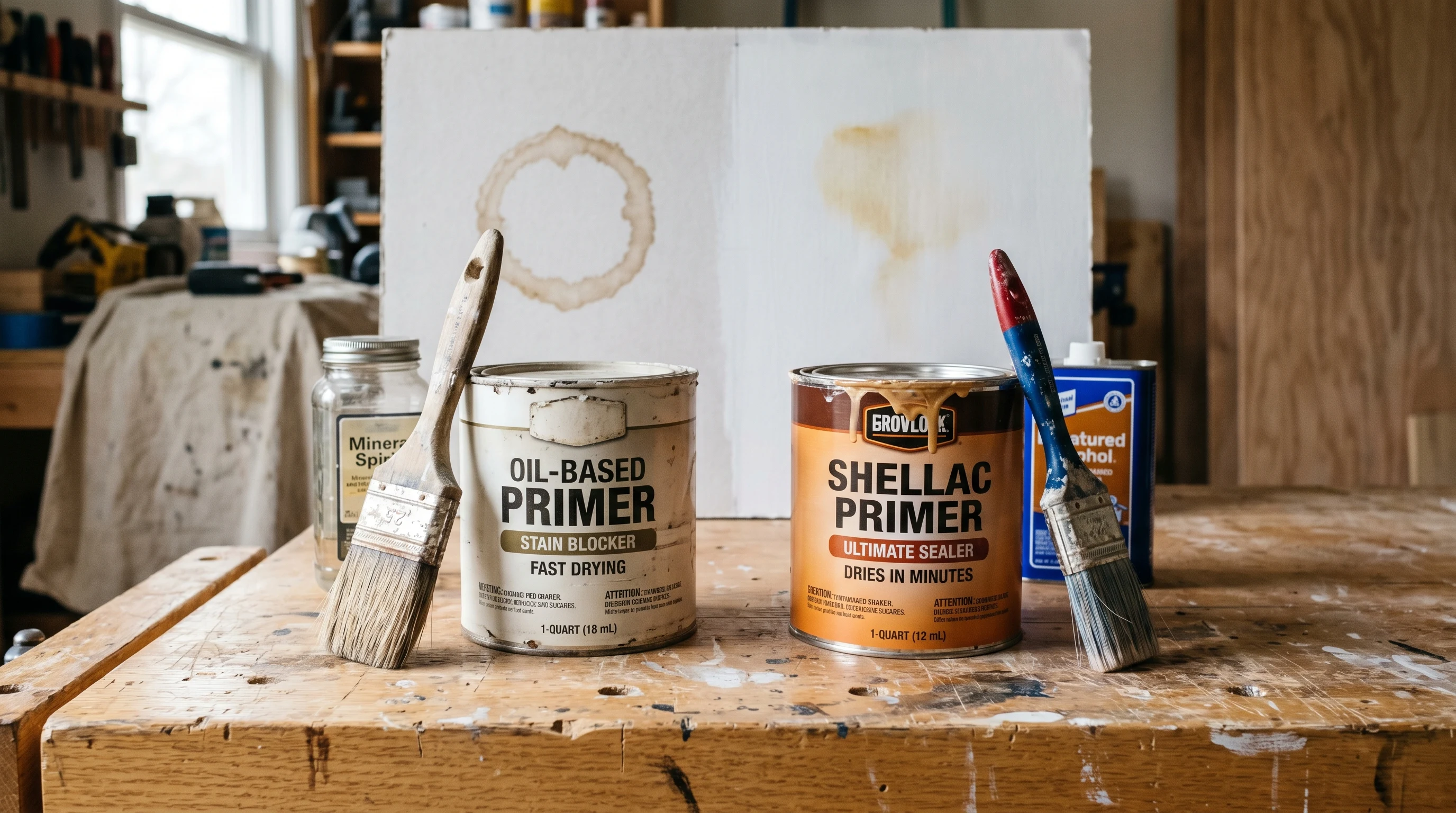
The 30-second answer
Both cans live on the same hardware-store shelf and both block stains nothing else can touch. The chemistries are completely different. BIN is shellac dissolved in denatured alcohol; it dries in 45 minutes by alcohol flash-off, locks down smoke and nicotine, bonds to glossy oil trim without sanding, and stays indoors. Cover Stain is a long-oil alkyd in mineral spirits; it cures by oxidation over 7-plus days, builds a tougher film for severe water damage and exterior wood, and asks you to wait overnight before a waterborne topcoat. Smoke ceiling, glossy trim, knot bleed, fast turn: BIN. Heavy water rings, exterior siding, foundation walls, large area: Cover Stain.
At a glance
| Zinsser Cover Stain | Zinsser BIN | |
|---|---|---|
| Resin class | Long-oil alkyd | Dewaxed shellac (lac-bug secretion) |
| Solvent | Mineral spirits | Denatured alcohol |
| Drying mechanism | Oxidative cure (binds with O₂) | Solvent flash-off (no chemical cure) |
| Touch-dry | 2-4 hours | 45 minutes |
| Recoat (label) | 1 hour (per can; see FAQ) | 1 hour |
| Full cure | 7+ days | ~24 hours |
| Smoke / nicotine | Good | Best in class |
| Heavy water rings | Best in class | Good |
| Knot bleed (cedar / pine) | Good | Best in class |
| Glossy oil trim adhesion | Needs scuff-sand | Bonds without sanding |
| Exterior use | Yes | No (shellac softens in UV + wet) |
| Cleanup solvent | Mineral spirits | Denatured alcohol |
| Topcoat compatibility | Any (after full dry) | Latex, oil, alkyd, shellac same day |
| Aerosol option | Exists, impractical at scale | Genuinely useful (popcorn, spots, knots) |
How the chemistries actually differ
Two different worlds.
Shellac is a natural resin secreted by the lac bug, harvested in India and Thailand, processed into flakes, and dissolved in denatured alcohol. BIN is roughly a 3-pound cut of dewaxed shellac with titanium dioxide loaded into the alcohol carrier. There is no chemical cure. The alcohol evaporates, the shellac reverts to its solid state, and a thin, hard, polar film stays behind. The sequence takes 45 minutes because alcohol flashes fast and shellac solidification is a phase change, not a polymerization.
Cover Stain is the opposite chemistry. The binder is a long-oil alkyd, an oil-modified polyester resin where roughly 60-70% of the molecule is fatty-acid oil chain. Mineral spirits is the carrier. When the spirits flash off, the alkyd is still liquid; it then cures by reacting with atmospheric oxygen to cross-link the unsaturated fatty-acid bonds into a continuous polymer film. The oxidative cure is slow: touch-dry in 2-4 hours, recoatable in a working day, fully cured at a week-plus.
Polar shellac in fast-flash alcohol vs nonpolar alkyd in slow-cure mineral spirits. Every other difference flows from there.
Stain-blocking strength
The right primer depends on what the stain is actually made of.
BIN handles water-soluble stains and bleed-through pigments better than anything else on the shelf. Smoke residue on a kitchen ceiling. Nicotine on the walls of a former smoker’s house. Marker, crayon, food splatter, mildew shadow, pet urine, tannin from oak and cedar and redwood. The shellac resin is polar and forms a continuous, impermeable surface; soluble tannins and nicotine compounds don’t dissolve in shellac and can’t migrate through it.
Cover Stain handles oil-soluble stains and persistent organic stains better than BIN. Heavy water-ring damage where the substrate has been saturated and is now mineral-laden. Old grease shadows behind a stove. Asphalt or roof-cement bleed-through. Mineral stains on basement walls. The alkyd film is thicker per coat than shellac, and the cured polymer holds out oily compounds the way an oil topcoat does.
The rule: if the stain dissolved in water, BIN. If it dissolved in oil, Cover Stain. Smoke and nicotine sit at the top of the BIN curve and the bottom of the Cover Stain curve. Don’t put Cover Stain on a fire-damage ceiling.
Winner: BIN on smoke, nicotine, knot bleed, and water-soluble organic stains. Cover Stain on severe water damage, mineral stains, and grease.
Dry and recoat windows
BIN is the fastest stain-blocking primer made. 45-minute touch-dry, 60-minute recoat, ready for topcoat the same hour. No oxidative chemistry to wait on. Prime a smoke-damaged ceiling at 9am and have it under finish paint at 11.
Cover Stain’s label says one-hour recoat. The label is technically correct and operationally misleading. One hour gets you a surface skin, but the cured film underneath is still gassing off mineral spirits for 12-24 hours. A second coat of Cover Stain inside that window is fine. Waterborne latex inside the same window risks solvent trapping: the latex film tries to coalesce while spirits are still escaping from below, and the bond suffers. Wait overnight for waterborne topcoats. Same-day works for oil-over-oil.
Winner: BIN. Decisively on speed.
Smell and cleanup
BIN smells like industrial alcohol: acrid, sharp, fast-flashing. The smell flashes off with the solvent, and an hour after the last brush stroke the room is breathable. Cleanup is denatured alcohol; rinse, work the bristles, rinse again, let dry.
Cover Stain smells like oil paint. Heavier, sweeter, longer-lingering. The mineral spirits don’t flash; they ooze out as the film cures. Open the can in a small bathroom and the room is unpleasant for the rest of the day and faintly noticeable into the next morning. Cleanup is mineral spirits. Takes longer.
For a small ventilation-limited room, BIN’s brutal-but-fast smell is preferable to Cover Stain’s steady fade. For an unfinished basement or open exterior with airflow, Cover Stain’s longer fade is unobjectionable. Neither primer should be used without ventilation.
Winner: BIN in tight spaces. Cover Stain is fine in ventilated work.
Adhesion to glossy substrate
This is where BIN does something nothing else does.
Shellac bonds to cured oil paint, glossy alkyd trim, varnish, and old shellac without scuff-sanding. The polar alcohol carrier wets the glossy surface, and the shellac keys into the substrate as the alcohol flashes. BIN is the only primer in mass-market production that bonds to high-gloss oil trim without surface prep. For a turn-of-the-century house with original oil-trim casing the homeowner doesn’t want to sand, BIN is the answer.
Cover Stain doesn’t have this property. Glossy oil trim under fresh Cover Stain peels at the bond line within months. The standard procedure is scuff-sand with 220-grit, dust off, then prime. The alkyd then bonds mechanically to the abraded film.
Winner: BIN. The “no sanding” claim is real and chemistry-based.
Film toughness against food, water, and grease
The two primers cure to different end states.
Shellac is hard, polar, and water-resistant from the moment the alcohol flashes. Wipe-down with a damp cloth: fine, immediately. Soap and water: fine after the topcoat. Shellac is softened by alcohol, so don’t clean a BIN-primed surface with anything containing alcohol or ammonia until the topcoat is on.
Cover Stain is the tougher of the two at full cure, but the cure is slow. Wipe down a Cover Stain-primed wall with anything wet inside the first week and the partially-cured film softens locally. This bites homeowners who prime kitchen cabinets on Saturday and try to wipe spilled coffee off the boxes on Tuesday. Wait the full week before any moisture exposure.
In practice, both films are usually under a topcoat within 24-48 hours, which makes the cure-rate gap moot for most jobs.
Winner: Cover Stain at full cure. BIN at every point before that.
Topcoat compatibility
BIN takes any topcoat. Latex, oil, alkyd, shellac, even epoxy. The cured shellac surface is chemically inert to common waterborne and solventborne topcoats. No wait, no scuff, just paint over it.
Cover Stain takes any topcoat too, but the timing matters. Once the alkyd film is fully cured, latex and oil both bond cleanly. Inside the cure window, waterborne topcoats risk solvent trapping and the bond can fail months later when the trapped mineral spirits finish migrating out. Same-day oil-over-oil if stacking coats; next-day waterborne over Cover Stain.
There is also a pigment consideration. BIN’s white is bright and crisp; Cover Stain’s white runs slightly warmer because of the alkyd resin’s natural amber tint. Under a thin coat of bright-white finish paint, the warm tint of Cover Stain ghosts through unless you topcoat at full build.
Winner: BIN. On compatibility, speed-to-topcoat, and color neutrality under whites.
A note on the aerosol cans
BIN aerosol is the right answer for popcorn ceilings. Brushing rips the texture off; rolling pulls strands. The aerosol lays a continuous shellac film without disturbing the texture. Reserve it for popcorn, knots, and spot priming on stains. Cover Stain aerosol exists and works, but cost-per-square-foot makes it impractical at scale. For a whole ceiling, a gallon and a roller is the right call.
Verdict by use case
- Pick BIN if: the stain is smoke, nicotine, marker, knot bleed, or water-soluble; the substrate is glossy oil trim you don’t want to sand; the surface is popcorn texture; the room is small and ventilation-limited; you need the topcoat going on within the hour; the primer will live indoors.
- Pick Cover Stain if: the stain is severe water damage with mineral content, grease shadow, or asphalt bleed; the substrate is exterior wood or masonry; the room has good ventilation and you can give the cure 24-plus hours before waterborne topcoat; the job is large enough that aerosol is impractical.
- It’s a tie when: the stain is moderate (a single old water ring, a few knots in pine), the substrate is interior drywall or flat trim, and either primer will solve the problem cleanly. Pick on whichever is on the truck and the topcoat schedule.
Top picks by side
Going with shellac? Zinsser BIN is the only mass-market dewaxed-shellac primer worth specifying. Gallon for whole-room work, aerosol for popcorn, knots, and spot priming. Verify: Zinsser BIN Shellac-Base Primer product page. Find a can: Zinsser BIN on Amazon.
Going with oil? Zinsser Cover Stain is the long-oil alkyd standard. Brush and roller on gallon scale; skip the aerosol unless you’re spot-priming a single mark. Verify: Zinsser Cover Stain Oil-Base Primer product page. Find a gallon: Zinsser Cover Stain on Amazon.
For the broader primer landscape (water-based stain blockers, bonding primers, masonry primers), see the primer round-up.
Related
- Best primer round-up: every primer class and where it belongs
- Water stains on ceiling: diagnosis and the right primer to seal them
- Yellowing trim: what’s bleeding through and how to lock it down
- Primer vs paint-and-primer-in-one: when the marketing claim doesn’t hold
- Bare wood interior: primer choice for trim, doors, and casework
Frequently asked questions
Can I topcoat BIN with latex the same day?+
Cover Stain says one-hour recoat on the can. Why do you say next day?+
Will BIN work on knots in cedar and pine?+
Is the BIN aerosol can actually as good as the brush-grade?+
Can I use BIN outside?+
- Best primer round-up: every primer class and where it belongs
- Water stains on ceiling: diagnosis and the right primer to seal them
- Yellowing trim: what's bleeding through and how to lock it down
- Primer vs paint-and-primer-in-one: when the marketing claim doesn't hold
- Bare wood interior: primer choice for trim, doors, and casework