Parking Lot Striping Paint: Specifier's Guide for 2026
Waterborne, solvent, and thermoplectic striping systems compared by DFT, retroreflectivity, and dry-to-traffic windows. MUTCD color spec, ADA layout, and the airless striper path that holds up to a year of de-icing salt.

Disclosure: Affiliate links to retailers. Recommendations are spec-driven.
Use case
Parking-lot striping has to survive UV, freeze-thaw, hot tire pickup, chloride from de-icing salts, and pressure-washing cycles at a dry film thickness under 10 mils. Service life runs 12 months on heavy-traffic retail, 24 months on office-park and medical-campus lots, and 3–5 years on light-use municipal lots without plows or salt. The work is regulation-driven: a strip mall that lets accessible-space markings fade below MUTCD-readable contrast is exposed to Title III ADA complaints; a warehouse that lets OSHA 1910.144 fire-lane red disappear is exposed at the next fire-marshal inspection. The spec writer picks a chemistry that meets the color spec, the state VOC ceiling, and the lot-closure window. Get those three right and the rest of the spec falls into place.
What gets striped, and to what color
OSHA 1910.144 and MUTCD 2009 Section 3A.05 control color use on private and public lots; confusing the two is the most common spec error.
| Marking | Color | Authority | Notes |
|---|---|---|---|
| Standard parking stalls | White | MUTCD 3A.05 | 4-in line; double-line for premium |
| Loading zone, crosswalk | Yellow | MUTCD 3A.05 | Separation of opposing traffic or caution |
| Fire-lane curbing, “FIRE LANE” stencil | Red | NFPA 1 / IFC §503; OSHA 1910.144 | Reserved for fire equipment and emergency access |
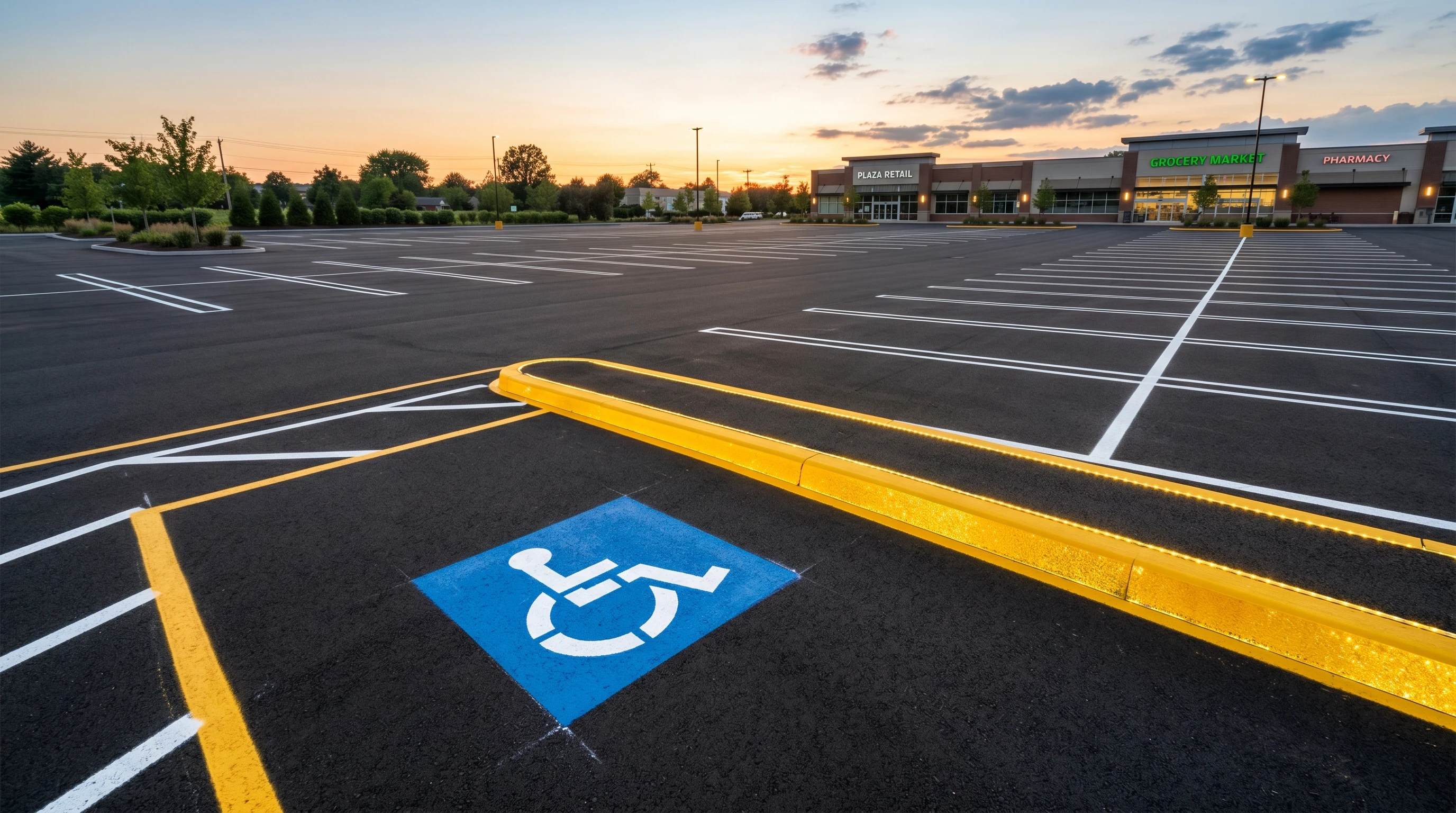
| ADA accessible-space symbol field | Blue | FHWA / ADA §502 | White symbol on blue field |
| Hazard, caution striping | Yellow + black diagonal | OSHA 1910.144 | 4-in stripes at 45° |
| No-parking hatched zones | White diagonal | MUTCD 3B.20 | Access aisles, end-of-aisle no-park |
Yellow on access aisles is the recurring violation flag. Designers default to yellow because it reads “no parking,” but ADA-trained inspectors and state accessibility audits cite it. White diagonal is the spec; yellow is for fire lanes and pedestrian separation only.
Spec requirements
| Spec | Value |
|---|---|
| Dry film thickness (DFT) | 12–15 mils wet, 5–7 mils dry per coat (waterborne acrylic) |
| Coverage @ DFT | 110–120 lf @ 4 in width per gallon (uncomplicated stalls) |
| VOC | under 150 g/L for waterborne (CARB / OTC compliant); under 450 g/L for solvent under SCAQMD Rule 1113 |
| Standards | ASTM D713 (road service), ASTM D2205 (specification), ASTM D2486 (scrub), AASHTO M-248 Type N |
| Glass beads | AASHTO M-247 Type 1 drop-on at 6–8 lb/gal for ASTM E1710 retroreflectivity ≥100 mcd/m²/lux |
| Pavement temp at application | 50–95°F substrate; air temp ≥50°F and rising |
| Humidity ceiling | 85% RH; dew point ≥5°F below pavement temp |
| Cure to traffic | 30–45 min no-track; 60–90 min vehicle traffic (waterborne, 73°F, 50% RH) |
| OSHA color code | 1910.144 — red (fire), yellow (caution / hazard), blue (information / ADA) |
| MUTCD color code | 3A.05 — white (same direction), yellow (opposing / separation) |
| ADA layout | §502 — 8 ft stall + 5 ft aisle (96 in van + 96 in aisle); 36 in symbol height |
These specs are not interchangeable. ASTM D713 is the road-service test (panel coated to DFT, mounted on a roadway, graded for adhesion, color, chip loss); skip it and the first failure is hot-tire pickup at the dock. ASTM D2205 governs the wet product in the pail (viscosity, fineness of grind, freeze-thaw); D2205-failed paint stripes fine on day one and skins over by day thirty. AASHTO M-248 Type N is what state DOTs reference; specifying it on the bid sheet forecloses cheap consumer-grade substitutions. A fire marshal looks for OSHA-red curbing, stenciled callouts, and clear access aisles read from a fire-apparatus seat. An ADA auditor pulls a tape on stall and aisle dimensions, the 36-in symbol, and the van-accessible ratio per §208.2.
System chemistry compared
Pick the chemistry first, then the brand.
| Class | Dry to traffic | Service life | $/lf installed | Best for |
|---|---|---|---|---|
| Waterborne acrylic | 30–90 min | 12–24 mo | $0.18–0.35 | Default commercial spec |
| Solvent (chlorinated rubber, alkyd) | 20–40 min | 18–30 mo | $0.22–0.40 | DOT roadway in non-OTC states |
| Thermoplastic (hot-applied) | 5–10 min | 5–8 yr | $0.85–1.40 | Highways, high-volume crosswalks |
| Epoxy / MMA cold plastic | 30–45 min | 4–6 yr | $1.10–1.80 | Toll plazas, structural deck markings |
Waterborne acrylic is the right answer for a typical commercial lot every time. Solvent dries faster in cold weather and is slightly more durable, but SCAQMD Rule 1113 caps traffic paint at 150 g/L in the South Coast district and the thirteen OTC states follow comparable rules; specifying solvent in California or the Northeast is a plan-review failure. Most contractors elsewhere have moved to waterborne anyway and won’t quote solvent unless asked.
Thermoplastic is operationally wrong for commercial lots. It requires a melter kettle, heated applicator, and a crew trained on hot extrusion; capital startup is $40K–$80K and per-day mobilization runs two to three times an airless striper. Below 50,000 sq ft of pavement (a 200-stall lot) mobilization swamps any per-foot premium, and most contractors refuse or load 40 percent above waterborne. Specify thermoplastic for highway work, transit lanes, and the one or two municipal crosswalks at 100,000 daily crossings.
Recommended systems
System A — Sherwin-Williams Setfast Acrylic Waterborne
The commercial striper standard. AASHTO M-248 Type N compliant, TT-P-1952F federal spec, ASTM D2205 conformance.
| Layer | Product | DFT |
|---|---|---|
| Surface prep | Pressure wash; spot-prime oil stains with shellac-based sealer | — |
| Stripe coat 1 | Setfast Acrylic Waterborne Traffic Marking Paint (white / yellow / blue / red) | 12–15 mils wet / 5–7 mils dry |
| Glass beads (optional) | AASHTO M-247 Type 1 drop-on at 6 lb/gal | — |
Sherwin-Williams Setfast product page · Search on Amazon
Setfast’s 30-min no-pickup time assumes 73°F / 50% RH; at 60°F and 75% RH on a shaded stall, expect 90–120 min. Freeze recovery is the second sharp edge: Setfast survives one freeze-thaw in the pail with vigorous mixing; a second cycle breaks the emulsion. Pails left on a March tailgate are scrap.
System B — Rust-Oleum Industrial Choice 2300 Inverted
Inverted-can aerosol for cart applicator or hand-layout work. Right for small lots (under 50 stalls), curb-paint, and touch-ups where rolling an airless isn’t justified.
| Layer | Product | DFT |
|---|---|---|
| Surface prep | Sweep clean; new asphalt off-gassed 30 days | — |
| Stripe coat | Industrial Choice 2300 inverted aerosol | 8–10 mils wet / 3–4 mils dry |
Rust-Oleum Industrial Choice 2300 product page · Search on Amazon
The 2300 bites contractors who push past its scope. The 3–4 mil dry build won’t hold up to a year of cart and truck traffic behind a big-box, and per-foot material cost runs double bulk waterborne when crews burn ten cans an hour. Service life is 8–14 months. Right scope: punch-list, parking decks, isolated curb runs, landlord touch-ups.
System C — PPG Aexcel-Stripe Waterborne
Federal Spec TT-P-1952F compliant, AASHTO M-248 Type N, used on DOT and federal work. Comparable to Setfast at a slightly lower 5-gal pail price through PPG distribution.
| Layer | Product | DFT |
|---|---|---|
| Surface prep | Pressure wash; pavement temp 50–95°F | — |
| Stripe coat 1 | Aexcel-Stripe Waterborne | 15 mils wet / 6 mils dry |
| Glass beads | AASHTO M-247 Type 1 drop-on at 6–8 lb/gal | — |
PPG Aexcel Pavement Markings page · Search on Amazon
Aexcel-Stripe tracks within 5% of Setfast on published benchmarks. It earns its spec on Buy American work, GSA leases, Postal Service distribution centers, and military bases requiring a TT-P-1952F line item. PPG’s industrial distribution is thinner outside the Midwest and Mid-Atlantic; verify supply on Mountain West projects with a hard occupancy date.
Equipment, by lot size
Airless striper (Graco LineLazer, Titan PowrLiner) is required above 50 stalls; throughput 4,000–6,000 lf/day single crew, 10,000+ two-person, slaved bead dispenser at 6 lb/gal. Cart applicator with aerosol cans for 10–50 stall lots, parking decks where airless weight is a problem, and touch-ups; 1,500–2,500 lf/day. Hand stencil, brush, roller for ADA symbols, “FIRE LANE” callouts, “RESERVED”, and curb painting. Plan symbol work the day after linework.
Surface prep, where next year’s restripe is decided
Fresh hot-mix asphalt must cure 30 days before the first stripe. Volatiles in green asphalt off-gas through the surface and lift the film if coated too early. If schedule won’t allow it, sealcoat first and stripe over the cured sealer at day 7.
Sealcoated asphalt is the better striping substrate; the sealcoat gives uniform texture and locks fines. Compatibility window matters: at day 3 a fresh sealer still carries surface oils that act as a release layer. Day 10 is the floor for routine work; day 14 for cool spring schedules in the 50s; day 21 for fall sealcoat in the Northeast. Verify with a thumbnail-press test (no impression, no wet sheen) and a blue-tape pull (no black pigment transfer) at a sun spot, a shaded spot, and a low spot. If both pass, run a 10-ft test stripe at spec DFT and inspect at 24 and 72 hours; lifting under a fingernail or ghosting at 72 says the sealer needs another week.
Existing painted pavement. Waterborne over old solvent is a delamination risk; scarify suspect solvent lines with a wire-wheel grinder or shift the new line 6–12 in onto virgin pavement. Layered paint over layered paint is the leading cause of mid-cycle peeling.
Concrete pavement (decks, garage floors) behaves like an industrial floor. Acid-etch or shotblast to ICRI CSP 2 minimum before the first stripe. Never paint over cure-and-seal compounds without a primer; they repel water and waterborne paint is water.
Application window
Striping is weather-bound work.
| Condition | Acceptable range | If violated |
|---|---|---|
| Pavement temp | 50–95°F | Chalky cure or flash-dry, uneven film |
| Air temp | ≥50°F and rising | Evening moisture under fresh paint, peeling |
| Relative humidity | ≤85% | Extended dry-to-traffic, sometimes 4+ hours |
| Dew point margin | ≥5°F above dew point | Condensation, blistering |
| Forecast | No rain for 4 hours, 12 preferred | Wash-off, ghost lines |
| Wind | under 15 mph | Drift, overspray on parked cars |
A 200-stall retail lot turns in ten hours: 7 AM empty, wash to 9, layout to 10, striper 10–2, stencil 1–4, reopen 3–4 PM with cones down until 6.
The asphalt-too-hot failure catches warm-weather crews. Black asphalt under July sun reads 130–150°F even with 90°F ambient; resin softens before it coalesces and the line dries glossy with picture-framing where binder migrated. Fix is a 5 AM start and hard stop by 11 AM, then a 4 PM window. An infrared thermometer settles the argument; if any of five readings is over 95°F, walk away. The cool-weather mirror is the dew-point rule: pavement temp must sit at least 5°F above dew point at application and stay there through the cure window. Check the NWS hourly dew point for the project ZIP, run the math against morning pavement temp, and abort if the margin is under 5°F.
Glass beads and retroreflectivity
For any lot operating after dark, drop-on glass beads are not optional. AASHTO M-247 Type 1 at 6–8 lb/gal produces 100–150 mcd/m²/lux fresh per ASTM E1710; the 30-mcd threshold is the restripe trigger. Beads drop into the wet film 1–3 seconds after the paint nozzle passes; most airless stripers slave the dispenser to the paint trigger. Hand-broadcast beads work for spot repairs but fail any FHWA-spec’d project. ADA spaces and the symbol field always carry beads.
Drop-on beads sit in the top half of the wet film, deliver max first-night retroreflectivity, and are the parking-lot standard; they are also the first thing to wear off. Intermix beads are factory-blended through the full film, deliver lower peak (75–100 mcd fresh) but a more durable floor in years two and three; highways spec intermix-plus-drop-on hybrids. Drop-on alone is sensible for commercial lots because the line gets restriped before intermix’s longevity materializes. AASHTO M-247 Type 1 (~600 micron) is the parking-lot bead; Type 3 (up to 1180 micron) is for high-build thermoplastic and leaves beads proud of a 6-mil waterborne stripe with no embedment. The decay curve runs 130 mcd day one, 100 at day 30, 80 at day 90, 50 by year one, below 30 mcd at 18–24 months in a salted northern lot.
ADA layout requirements
ADA §502 and §208 control accessible-space layout: 96-in standard stall (132-in van-accessible alternative); 60-in access aisle (96-in van) in white diagonal at 36-in spacing; 36-in International Symbol of Accessibility, white on blue; 1 per 25 total up to 100, 1 of every 6 van-accessible; reserved signage at 60-in minimum mounting with “Van Accessible” subplate where applicable. Re-striping is the easiest moment to true up the layout. A lot striped to 1992 ADA defaults often has 8-ft stalls with 5-ft aisles and no van-accessible space; bringing it to code is a one-day delta on a routine restripe.
Failure modes & how to prevent them
Peeling within one season. Long ribbons lift along the centerline from the ends inward; substrate is clean, failure at the bond line. Cause is a prep failure: green asphalt still off-gassing, loose sealcoat, or an oil stain whose silicone broke the bond. Prevention is the prep spec: 30-day asphalt off-gas, degreaser on oil, 10-day sealer cure verified by thumbnail-press.
Ghosting after re-stripe. Old line shows as a faint shadow under sunlight, most visibly where yellow was overcoated white. Cause is UV-accelerated pigment bleed. Fix is shellac-based stain blocker (BIN, Cover Stain); acrylic primer doesn’t block it. Prevention is to overcoat the same color or shift the geometry 6–12 in onto virgin pavement.
Fading and chalking by month 6. White turns gray, yellow turns buff, surface chalks on a finger swipe. Line still adheres but color compliance is gone. Cause is off-spec consumer “traffic paint” without the AASHTO or federal callout. Prevention is the bid sheet: require AASHTO M-248 Type N or TT-P-1952F by number.
Hot tire pickup at the loading dock. Rubber-tread imprints lift the film in matching strips along the dock-truck path while drive aisles and stalls stay fine. Cause is thermal-mechanical stress from loaded trucks turning on hot pavement. Fix is 7 mils dry DFT in the dock zone, or upgrade that zone alone to MMA cold plastic at $1.10–$1.80/lf.
Retroreflectivity dropoff under salt. Lines look fine in daylight but disappear under headlights at 50 ft, with mid-winter readings below the 30 mcd threshold on October-striped lots. Cause is salt abrasion and plow scrub. Fix is a March re-bead pass on the highest-visibility lines (fire lanes, ADA borders, drive-aisle centerlines) over a thin clear-acrylic tack coat.
Cost & yield math
The working number is linear feet of 4-in line per gallon. At 12–15 mils wet, a gallon of waterborne covers 110–120 lf. Glass beads at 6 lb/gal add roughly $0.04/lf. A big-box stall (9 by 18 ft with a 4-ft return) is 22 lf single-line or 28 lf double-line. A 200-stall lot consumes 4,400 lf, or 37–40 gallons plus 240 lb of bead, plus 5–8 gallons for symbols.
Installed cost: $0.18–$0.35/lf waterborne, $0.22–$0.40 solvent (where allowed), $0.85–$1.40 thermoplastic. Curb painting surprises owners: red fire-lane curb with stenciled “FIRE LANE NO PARKING” runs $1.20–$1.80/lf because brush work is hand-applied and the two-color stencil doubles labor. DIY makes sense under 20 stalls where the $400–$800 mobilization swamps paint and labor. The math flips at 30 stalls; above 100, hiring out is not a question. Get three bids above 50; 30 percent variance is normal, over 50 percent means a bidder is reading the scope wrong.
Where to buy / spec
| Channel | Best for |
|---|---|
| Manufacturer-direct (SW Setfast, PPG Aexcel, Rust-Oleum 2300) | Spec’d portfolios, rep support, bulk 5-gal pricing |
| Industrial distributor (Pavement Supply, SealMaster, Brown Co) | Bulk paint, beads, stencils for striping contractors |
| Pro retail (Sherwin-Williams stores) | Local 5-gal pickup, contractor pricing |
| Amazon Business | Aerosol-can stocking for cart-applicator work |
Specifier’s bid language
“Provide and install AASHTO M-248 Type N waterborne acrylic traffic marking paint per Sherwin-Williams Setfast specification (or approved equal: PPG Aexcel-Stripe, Ennis-Flint waterborne). DFT 12–15 mils wet, 5–7 mils dry per coat. Pavement temp 50–95°F at application; air temp ≥50°F and rising; humidity ≤85%; dew point ≥5°F below pavement temp. Glass beads AASHTO M-247 Type 1 at 6 lb/gal applied wet on all lines. Color compliance per MUTCD 3A.05 and OSHA 1910.144. ADA accessible-space layout per ADA §502 verified and corrected to current code. Contractor carries $2M aggregate GL, provides SDS, and warrants minimum 12 months adhesion.”
The 12-month adhesion warranty is the floor. Reputable contractors will warrant 18–24 months on a properly sealcoated substrate. Push back on bids under 12 months unless the lot is unsealed and high-salt.